Monday, October 09, 2006

Direct Action


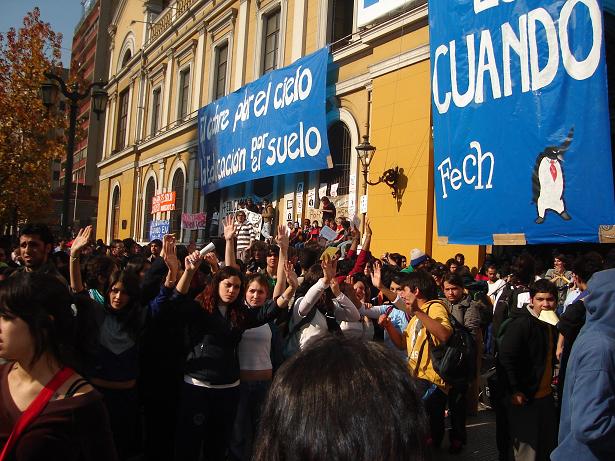
Yet another example of how direct action through mass mobilization can lead to a more democratic process took place in Latin America this year. This time it was in Chile. The honeymoon for the "first-ever woman elected president" Michelle Bachelet ended in April of 2006 as Chileans "organiz[ed] against market-based education" (International Socialist Review, Sept. 2006), which Bachelet showed no signs of ending. It's odd that Bachelet was reluctant to reform the educational system that her once arch-enemy, Pinochet, established as means for providing huge profits to private industry. However, where Bachelet seemed complacent, the students seemed more than willing to motivate Bachelet to action!

Not too long ago, I remember being struck by many progressives' enthusiasm for Bachelet despite her unabashed support for neoliberal economics through free trade agreements. Sure, she was knowingly elected as a "social democrat" that promised that in Chile "la Alegria ya viene" ("happiness is on the way"). While several improvements may have taken place, including the end of "senator-for-life" appoinments, the immense wealth generated by Chile's copper is still not reaching its poor. One of the notable area's of Chilean society not receiving any benefit from Chile's copper wealth was education. The reaction should therefore not be surprising.


What has ensued is a mass mobilization unwitnessed in Chile since Pinochet. Most of the protests and marches have been led by student/parent/teacher groups. Some have actually led to takeovers of school buildings. There has been repression and arrests of students, but this has only lended itself to the continued rise in numbers protesting the government's repressive actions. "Among the students' short term demands were free bus fare and the waiving of the university admissions test (PSU) fee, while the longer term demands included: the abolition of the Organic Constitutional Law on Teaching (LOCE), the end to municipalization of subsidized education, a reform to the Full-time School Day policy (JEC) and a quality education for all" (Wikipedia: "2006 student protests in Chile").

Since April, 2006 nation-wide mobilization and protest had grown. Students were joined by parents, teachers, administrators as well as other trade unions. As the movement grew so did the police repression. The Minister of Education, Martin Zilic, continually refused to meet with the students further provoking their protestations. President Bachelet had to take notice of the growing protests. Finally, in response to school-takeovers, Bachelet began to sound like a man that was once responsible for her own capture and torture: Pinochet. Bachelet said: "Let me be crystal clear. What we have witnessed over recent weeks is unacceptable. I will not tolerate acts of vandalism or intimidation. I will apply the full force of the law."

On June 5, 2006 an estimated 900,000 students assembled for a national strike. This was the largest mobilization since 1972! The students are not buying Bachelet's bill of goods who has told the students there is no money. A student was quick to point out that for the "price of just one of the seventeen F-16 jets she bought for the armed forces this year is enough to cover all or our demands."

The movement forced the president to concede to create an advisory committee. While the students pointed out that the committee should consist of "students, teachers, school administrators, education experts and other social stakeholders...[and that] half of them should be determined by the student assembly," the government explained that the president was free to decide who would be included. Six of the 73 members of the committee are high school students. With the formation of this committee, the students agreed to end the strike, return to school and continue negotiating for the end of the LOCE, a notorious legacy of Pinochet and neoliberal economics.

To me, the most important lesson learned from our Chilean brothers and sisters is the effect of direct action as a means for achieving change when the representative deomcratic system seems to represent/favor mostly the interests of the polictical and economic elite. Watching the changes in Bolivia, Venezuela, Peru, Ecuador, Chile, Argentina, Brazil, et. al. is inspiring. As long as the U.S. is tied up in Iraq, it seems that there may be too many fires for our government to put out. Recent events in Oaxaca, Mexico are yet another example of popular resistance led by teachers. Que viva los maestros y los estudiantes!

Sunday, October 01, 2006

Who Can Afford Life?


What a truly dysfunctional society we have created that tells us that some lives are worth more than others. Only those that can afford a safe car, car seats, side-collision airbags, reinforced steel, etc., etc… “Larger, heavier cars with poor ratings may easily produce better results than smaller cars with good ratings” (safecarguide.com). But who can afford the heavier cars? For that matter, how many poor families in poor states like Montana—which happen to have very high traffic fatality rates—can afford a new car with basic safety features at all? Besides, even if you’re lucky to be in one of the safest small vehicles, you will still not survive a collision with Richie Rich’s Hummer.

What does a poor family choose to do as winter nears and they have to decide whether or not to buy much needed new tires to make their cars safer or to take their sick children to the doctor during flu season? The fact is money doesn’t go far enough and millions of American families are forced to make decisions that one should not be forced to make.

Health care is but one of many factors in the widening gap of haves and have nots. Fewer and fewer Americans can afford the best medical care. The rest are left to decide whether or not they should tough out preventable and curable illnesses. Disclaimers, caveats and loopholes make many group medical plans (HMOs, etc.) dangerously deceiving to unsuspecting and ignorant policyholders. In some cases, specific procedures that are necessary for survival are seen as “elective,” such as some organ transplant surgeries. Millions of Americans depend on their employee insurance to protect them and their families, yet are completely unaware of exactly what their insurance affords them. Besides, the out-of-pocket expenses make insurance a less-than-effective means for sound health care. Again, the “unaffordability” of health care determines that only a select group of people are worthy of care.

It is striking to think of the political platform of many American politicians and their supporters that claim to be against abortion, calling themselves “pro-life.” In many cases, these same politicians are the ones that are against socialized medicine—a system of medical care that nearly all of the first-world countries employ. Not coincidentally, first-world countries with socialized medicine have much better overall public health and health care. What on earth are we waiting for? A “pro-lifer” seems to be telling the world that they are “pro-life” only up until the point that the person is born, then afterwards…not so much!

Money buys one the means of production, influence, power, safe cars (that kill the people in the little cars), best lawyers, best education, best houses, best cars, best health care, best food, luxury items, best clothing, best vacations, and on and on…those without money, well…I guess you can join the rich man’s army and fight their wars.

The sickness of capitalism is further highlighted in “terminator seeds.” Terminator Technology, a brainchild of the monstrosity known as Monsanto, was designed as a means for restricting the natural process of seed regeneration, thereby forcing farmers to purchase their seeds each year from, you guessed it: Monsanto and Co. To me, very few modern business practices more eloquently express the incompatibility of a capitalist system and the natural order. A company thinks up a way to create an everlasting monopolistic dependency by modifying the most basic processes of life: life itself. The process creates seeds that are sterile so that they can not regenerate. Perhaps this is capitalism at its worst, but innumerable cases such as Monsanto abound, and they only serve to add more evidence of its “anti-life” by-products.

Capitalism cannot be reformed, nor would an informed and aware populace wish to reform it. Since the world is divided into a capitalist class and a working class, the work must be to continue to point out to the working class the absurdity and “anti-life” nature of capitalism. We must be made more and more aware of the oppressor. This work involves highlighting the fundamental disparity between capitalism and democracy. Theses two concepts have been too closely linked and they should be clearly demarcated through education.

The Wobblies, IWW, in Butte, Montana from 1905-1920 believed that the raising of the social consciousness and the overall education of the working class was a natural process of direct action. They believed that true revolutionaries would lead the revolution through direct action and the working class that participated in these actions were learning of the actual power, inherent rights and dignity they had when they acted.

Perhaps many once believed that the feudal system was inevitable, immutable and eternal. Yet a quick glance through history reminds us that there is a definite trend towards libertarian socialism. Long live the social revolution!

Tuesday, September 12, 2006

The Superbowl of Fascism


Italian philosopher Giovanni Gentile described "fascism" in an entry in the Encyclopedia Italiana as such: "Fascism should more appropriately be called corporatism because it is a merger of state and corporate power." (Although Gentile should be properly credited with this original definition of "fascism", Benito Mussolini would later strike Gentile's name and add his own). Bearing in mind this definition, what do the terrorists in Afghanistan have to do with "fascism"? They are neither a state nor corporation. On the other hand, what can be said about those fighting the terrorists? Is there a trend of the "merging of corporate and state power" in the U.S.?

Score after definition #1: American fascists-1, Islamofascists-0

According to Wikipedia, the definition of fascism should include other important distinctions: "Fascism is a radical political ideology that combines elements of corporatism, authoritarianism, nationalism, militarism, anti-anarchism, anti-communism, and anti-liberalism." Again, the question stands: what similarities are there between trends in this country and this definition of fascism? Does "militarism" apply? "Nationalism"? "Corporatism"? How about something as simple as "anti-liberalism"? Also included under this definition, we begin to see some the characteristics of fundamentalist Muslims as well.

Score after definition #2: American fascists-7, Islamofascists-6


Returning to history, in 1944, Vice President Henry A. Wallace, described a "fascist" as "one whose lust for money or power is combined with such an intesity of intolerance toward those of other races, parties, classes, religions, cultures, regions or nations as to make him ruthless in his use of deceit or violence to attain his ends." In this case, perhaps many Americans leaders and CEOs could fall under this definition as easily as the terrorists they claim to hate. I remember hearing a therapist once say something about "
projection"... Could it be that American fascists (or Islamic Fundamentalists) are full of self-hatred for falling below their own basic standards of humanity and attributing their own unacceptable behavior to another? Here I am giving both groups the benefit of the doubt, granting them human status and wishing they could be extricated from their denial. Unfortuanately, the result of this denial is the incredibly inhumane treatment of oneself and others.

Score after definition #3: American fascists-17, Islamofascists-15

Wallace continues: "The supreme god of a fascist, to which his ends are directed, may be money or power; may be a race or a class; may be a military, clique or an economic group; or may be a culture, religion, or a political party." It's interesting that Wallace invoked a religious concept to describe a fascist's blind obedience, since in the case of both "American fascists" and "Islamic fascists" a central element of their ideologies of hate is a religion: Christianity and Islam. Tragically, neither group seems rational in their understanding of the central messages of their "messiahs": PEACE! A closer examination of this portion of Wallace's definition is instructive for an evaluation of current American fascists since his definition includes a dogmatic worship for institutions beyond religion, such as a "political party," or a "military," or a "culture."

Score after definition #4: American fascists-27, Islamofascists-23

(In the case of "culture", much more could be said, however, it is worth noting that neither fundamentalist Christians nor fundamentalist Muslims are reflecting the central tenets of their religions, but instead the distorted morality of their cultures. Too many Christians are unable to reconcile their capitalist lifestyles with the more benevolent message of Christ. Similarly, a harsh culture of theocratic rule that conveniently imposes a highly deterministic interpretation of the Koran on its followers in order to maintain power, have stifled a good deal of secular humanist growth in the Islamic world.)

Wallace also points out and gives distinction to a type of American fascist as someone who would not necessarily resort to violence, but instead: "[h]is method is to poison the channels of public information. With a fascist the problem is never how best to present the truth to the public but how best to use the news to deceive the public into giving the fascist and his group more money or more power." Perhaps this portion of the definition is more easily located with the American fascists since they overwhelmingly control access to information, but a dearth of divergent viewpoints in the Muslim world lends itself to concept of controling "truth."

Final Score in the Superbowl of Fascism: American fascists-30, Islamofascists-25

Sadly, the toll of modern day "fascism", if that is what it should even be called, is obviously tragic. More important to me than the thought of who is being more fascist, is that as an American, I am obligated to prevent the crimes of my country--full stop--.


The Rise of American Fascism

Project for the Old American Century

Henry A. Wallace's The Danger of American Fascism


Tuesday, July 18, 2006

It's Not Ours to Destroy


In light of the on-going misinformation emanating from the Middle East, I implore you to find information and evidence contradicting prevailing attitudes towards this crisis that exists in abundance, but that is almost completely ignored by our media. If one were to watch any of our major news networks ranging from Fox News to CNN, one would get the impression that Israel is defending itself. This is a very convenient misimpression for the Israeli, U.S. and British governments. On the other hand, this is most inconvenient if one is Lebanese or Palestinian. The asymmetry of death and destruction in the region (“
More than 200 Lebanese, most of them civilians, and 24 Israelis have been killed in the fighting”/ “Lebanese civilians are being killed by savage aerial bombardment from at least 2,000 sorties by Israeli war planes.”) is strangely analogous to the asymmetry of media coverage. No one seems to be reporting anything but politically deterministic positions. Politicians, right in step with the media, are also clamoring for solidarity with Israel, including Senators Joe Biden and Hilary Clinton…solidarity with a country that is raining down hell and fury on the innocent people of Palestine and in Lebanon with complete impunity.

A small amount of research would yield far different results and explain why the international community is condemning the actions of Israel. Perhaps by learning that this most recent phase was actually begun around the beginning of June as Israelis fired missiles and killed 9 Palestinians in Gaza, or perhaps we should know that an Israeli soldier was “captured” (not “kidnapped”) in response to an actual “kidnapping” of a doctor and his son by Israeli soldiers on June 24. The reporting on the “capture” of Corporal Gilad Shalit is well reported and therefore stirring sympathy. Conveniently, or inconveniently depending on one’s point of view, the “kidnapping” of the doctor and his son is unreported. This “kidnapping,” after all is a war crime, as is the killing of the 9 Palestinians back in beginning of June. Conveniently then—for the Israeli government—no one cares to report on these crimes. Just like no one wants to—or perhaps, is “allowed to”—report on the actual chain of events and extremely disproportional “response” by Israel against Lebanon.


So please, don’t allow the media to shape your opinion. As Americans we are funding these tragic deaths (there is no such thing as an “Israeli gunship”, MADE IN USA!). We owe it to the innocent/non-collateral victims of violent self-proclaimed masters throughout the world to stop this killing machine. We must remember a truism, which is that we must first concern ourselves with our own crimes. We can and must stop our government from funding this tragedy. We must denounce the media for its role in this crime. Be brave to speak the truth, even with loved ones, as there are definitely healthy and positive ways to speak to ill-conceived notions. Remind our friends and family that America is not the world and that there must be resounding reasons why the U.S., Israel, Marshall Islands and Britain vote alone on U.N. resolutions that pass unanimously each year (170 to 4) condemning Israeli behavior in the region, or condemning U.S. behavior towards Cuba (171 to 3, as even Britain disdains the Cuban Embargo).


In a world of diminishing safety and security (due to our own actions), we grow reactive and reactionary. Our choices as consumers, our pursuit of convenience and wealth, our choices…our choices… What kind of thought goes into our choices? One American Indian perspective that I shared with my students this year was that we are borrowing our world from our grandchildren and great grandchildren and great-great grandchildren ad infinitum. Well, I’ve tried to make up an analogy of loaning someone something you covet only to have it returned destroyed and useless, but there is nothing that can compare to the precious gift that is Mother Earth and human life. Words fail to describe the power of the choices we are making for future generations. We must act now to stop war everywhere. We must stop our government from selling arms and ammunition to foreign governments. We must disarm our own country immediately. We must remove the capacity of destruction from human hands and we must start with our own. We must also act today to end our assault on Mother Earth. Today, I ride my bike. Tomorrow, I walk.

http://www.zmag.org/content/showarticle.cfm?SectionID=107&ItemID=10577

http://www.zmag.org/content/showarticle.cfm?SectionID=107&ItemID=10591

http://www.zmag.org/content/showarticle.cfm?SectionID=107&ItemID=10589

http://www.zmag.org/content/showarticle.cfm?SectionID=107&ItemID=10590

Friday, June 16, 2006

Rascism and Demagoguery in the Governor's Mansion


Dear Gov. Schweitzer and other "bashers",

What would be wrong with calling Governor Schweitzer a "dictator"? Would it be harmful? Would it be politically-incorrect? Would it simply be inaccurate? Or would it sound ludicrous, possibly driven by ideology or irrational prejudice?

On two separate occasions, Governor Brian Schweitzer (D-MT) called Hugo Chavez a dictator. In a 60 Minutes interview with Lesley Stahl, Schweitzer said: "'Why wouldn’t we create an economic engine that will take us into the next century, and let those sheiks and dictators and rats and crooks from all over the world boil in their own oil?' Schweitzer has called them rats and crooks and hasn't held back on bit. 'Hugo Chavez, the Saudi royal family, the leaders of Iran,' he said. 'How about the countries that end with 'stan'? Nigeria? You tell me. Sheiks, rats, crooks, dictators, sure.'"

Calling Hugo Chavez a "dictator" is harmful, irresponsible and deserves our strongest condemnation! Hugo Chavez has been DEMOCRATICALLY-elected three times (one was a recall referendum). Each of these elections were observed by myriad election observers from around the world.

The Organization of American States and the Carter Center held a joint press conference proceeding the recall election. OAS Secretary General Cesar Gaviria and Nobel Peace Prize winner and former U.S. President Jimmy Carter declared: "electoral observation mission's members had found no element of fraud in the process." In fact, several observers commented that the elections in Venezuela were much more legitimate than those in the U.S. (Florida 2000/Ohio 2004).

Interestingly, what people admire about Chavez and Schweitzer is their tough talk. However, a rational analysis of their rhetoric would bare extremely different results. For one, a rational observer would see that Chavez bothered to check his facts before commenting, while Gov. Schweitzer's comments would be an impassioned appeal to the prejudices and emotions of uninformed and frightened mass of Americans seeking order and security. The latter's comments more accurately describe the behavior of a dictator!

Gov. Brian Schweitzer clearly cannot mean what he has said on more than one occasion about Hugo Chavez, so we must disregard his comments. The reason he and others cannot have meant what they said is because of the level of deep rascism that it would require to hold this belief. By lumping Hugo Chavez, his majority supporters, the millions of Arab and Muslim people, or anyone who might oppose being treated as cogs in a machine that serves a miniscule minority into one group as "the sheikhs, the dictators, the rats and crooks around the world who are bent on destroying our way of life," is a textbook definition of rascism. This attitude conveniently ignores fact. To find the sheikhs, dictators, rats and crooks one need not look any further than the buried mirror that conveniently denies and defies honest self-reflection!

The overwhelming majority of people in Venezuela support Chavez (approval rating of Chavez is higher than Schweitzer's: 70%). National pride in that country is based in revolutionary missions that are serving a country's essential needs. Hugo Chavez has led a charge to feed, house, educate and medically treat its people. Hugo Chavez has criticized American foreign policy and stood up to ignorance and irrationality in a time of extreme rascism and global crises. Billions of people that suffer the effects of environmental devastation, smash-and-grab mentalities from imperial countries, and a rascist misunderstanding of their situation have found a powerful voice in Hugo Chavez.

Monday, April 10, 2006

Ending Isolation and New Beginnings


"The greatest trick the devil ever played was convincing the world he didn't exist."
--Verbal Kent in the film The Usual Suspects

Corporations have had similar success. These private tyrannies have been able to rape the world with very little effective resistance, especially in the country which harbors these criminal institutions. Alexis de Tocqueville warned us in Democracy in America that he knew of
"no country in which there is so little independence of mind and real freedom of discussion as in America." However, the unchecked and unqualified belief we Americans have in our democracy makes us much less aware of the oppressive institutions. We are effectively rendered powerless beyond an occassional trip to the ballot box.


I do find hope however, even if that hope is something that will likely need to be imported. Venezuelans are inspiring. When President Hugo Chavez was temporarily removed from office by a U.S.-backed coup d'etat, and Venezuelans had no leadership that was further hampered by a complete communication blackout, they spontaneously took to the streets despite vicious and brutal police repression. It was as though the collective consciousness of Venezuelans banded them together in solidarity and said, "Let's not allow this coup. Let's take our country back!" And that is exactly what they did. Without any leadership or central organization the people of Venezuela took their country back and resisted tyranny.

This kind of grassroots consciousness gives hope to the idea that the Bolivarian Revolution is much bigger than just one man. It gives hope that what really stands in the way of taking measures into our own hands is ourselves. Though the obstacle of forfeiting our material comforts and facing the most powerful institutions in the world is nothing to take lightly, it is worth considering the old adage of Karl Marx: "We have nothing to lose but our chains."

So if you're ready and would like to join me, let's start a revolution. Let's start creating our own security and order from within. Let's reassure each other that the constitutive tension we feel from being so dependent on everyone around us even though we know nothing about each other (both of which are effects of capitalism and the modern society: atomized yet interdependent) can be changed by taking our lives back and connecting. Join a social justice group or start your own. Whatever you do, get connected. Get to know the people in your community so we can stop fearing the people upon whom depend for all kinds of unknown reasons. Let's talk about issues and stop allowing the institutional terror that is isolating us to take control. We must stop fundamentalists and reactionaries from driving the collective consciousness of this nation towards greater fear and isolation. Let's unplug from the media, advertisers, fundamentalist clerics (Christian, Muslims, et. al.), government, and public education. Let's stop speaking truth to power and start speaking truth to each other! The revolution starts now!!!

Saturday, March 11, 2006

"Why do they hate us?"


President Bush and the power elites know the true answer to the question “Why do the hate us?” They know, for instance, that it is their very existence, self-serving over-indulgence, mass murder and policies of hate that have brought on the wrath of the world population. In order to avoid a correlation being made between the suffering/oppression abroad and that closer to home, the elite has depended on its most important institutions (education, religion, media, et. al.) to perpetuate a myth that Americans are “one nation, under god, indivisible, with liberty and justice for all.” Nothing could be farther from the truth. In fact, the working class of this country shares nothing but benign intent in common with the ruling class. Therefore, it must be a prime directive of American politics to clearly differentiate between the American working class and the rest of the world’s poor, colonial working class. The elite must seek to prevent Americans from empathizing—despite its basis in reality—with Muslims, Cubans, Colombians, Venezuelans, Vietnamese, Indians, Haitians, and Africans that have suffered imperial brutality for centuries. This way, those that “hate us” will not become Americans.

What do any of us share in common with the world’s powerful elite that is meaningful? For instance, I can’t use patriotism to buy food. I cannot pay for my medical bills with the “American Dream.” I cannot own a home with the Pledge of Allegiance. I cannot stop the most violent nation in the world from killing more innocent people with the “Melting Pot”, let alone the U.S. Constitution. (Hell, no one can stop the president from breaking the law these days!) Do we share their values? There is a pathetic manufactured perception that the American masses are “just like” their political and economic elite. However, evidence does not bring to bare this reality. Economically, this country’s inequality is a human rights violation. How can the wealthiest nation in the history of the world let its own people starve, live without homes, or equal access to health care? To deliberately perpetuate a class system, by refusing to end the cycles of poverty, and institutional, individual and social racism, this country’s elite—through its actions not its words—is loudly pronouncing just how much it appreciates the masses.

Taking for granted the uncommon ground we, the working class of the world, occupy—one that is morally high and righteous—and they, the ruling elite, occupy—one that is morally bereft and cruel, I would like to posit this: why do they hate us? That is, why do the elite hate us, not the other way around? They hate us because we control their future. We can refuse to do their work. We can refuse to fight their wars. We can refuse to shine their shoes. We can and must refuse to perpetuate their lies and myths.

Sunday, February 26, 2006

Socialism Will Smash the Capitalist World-Economy


While it is necessary for a socialist economy to be run for the benefit of the vast majority of the people rather than for a small aristocratic, plutocratic, or capitalist class in order for it to be considered “socialist”, its use of markets is not “unsocialistic”. In fact, socialist economies must adhere to the laws of the market as much as any other economy without being capitalistic. Therefore, a socialist economy can operate without contradiction or the risk of undermining its principles within the global market economy. It should therefore be understood that Venezuela’s exploitation of its only comparative economic advantage—oil—in the global capitalist markets is not a contradiction of principles. It would, however, lack socialist principles if the wealth generated from its oil failed to benefit the majority of its people. Most importantly, socialist countries such as Venezuela—unavoidably intertwined in the modern world-economy which is capitalist—must look to export its ideas above all else and help lead the systemic destruction of global capitalism. Backed by the momentum of Venezuela, global access to information and destabilizing societies across the world, socialism has reached an historical turning point and it must lead the way in shaping a more socially just and democratic world.

Capitalism and the World-Economy

One possible way to better understand socialism is to distinguish it from the capitalist system that dominates the world-economy. A capitalist economy gives priority to the endless accumulation of capital. However, if we say that a system “gives priority” to such endless accumulation, it means that there exist structural mechanisms by which those who act with “other motivations” are penalized in some way, and are eventually eliminated from the social scene, whereas those who act with the “appropriate motivations” are rewarded and, if successful, enriched.

According to economist and historian, Immanuel Wallerstein:

World-economy and a capitalist system go together. Since world-economies lack the unifying cement of an overall political structure or a homogenous culture, what holds them together is the efficacy of the division of labor. Historically, the only world-economy to have survived for a long time has been the modern world-system, and that is because the capitalist system took root and became consolidated as its defining feature.

Fortunately, the biggest weakness of the capitalist system is that it cannot exist within any framework except that of a world-economy. A world-economy with so many strikingly conflictive interests is too tumultuous for capitalism’s long-term survival, especially considering the explosion of readily-available and accessible information that is reaching more people in more manifold ways. Capitalism demands a very special relationship between its capitalists and the holders of political power. If the latter are too strong, their interests will override those of the economic producers, and the endless accumulation of capital will cease to be a priority. So what would this mean for capitalism if political power were held by an increasing number of people, the working class, or a “rogue” nation such as Venezuela? Another weakness of capitalists it that they require not only a large market but they also need a multiplicity of states that are willing to work in favor of “their interests”. This means that capitalists must work incessantly and exert massive efforts to maintain “their interests”. So how do capitalists ensure their future?

Socialization

Even in the modern world of mass information, households still serve as the primary socializing agencies. They seek to teach us knowledge of and respect for the social rules by which we are “supposed” to abide. They are of course seconded by state agencies such as schools and armies as well as by religious institutions and the media. But none of these come close to the family in actual impact. What however determines how the households will socialize in their members? Largely the way in which the secondary institutions frame the issues for the households demonstrates exactly how to socialize one’s family members. It also cannot be understated the how defenseless overworked and fractured families are to the effects of oppressive secondary institutions.

Of course, the powers that be in a social system always hope that socialization results in the acceptance of the very real hierarchies that are the product of the system. They also hope that socialization results in the internalization of the myths, the rhetoric, and the theorizing of the system. Although this does happen rather comprehensively in highly nationalistic countries such as the U.S., it never fully takes root (thanks to dialectical dissonance). On the other hand, there are some families that socialize their members to be rebellious, critical-thinking and self-reliant. To be sure, up to a point even such antisystemic socialization can be useful to the system by offering an outlet for restless spirits as long as the overall system is in relative harmony. In such cases, it is predictable that such anti-establishment socializations will have only a limited impact on the overall system. However, when the historical system comes into structural crisis (viz. 1960s) suddenly such antisystemic socializations can play a profoundly unsettling role for the system.

There is little question that across the globe today, people are more fully aware of the political issues that affect their personal lives then at any time in the past. They are more aware, more willing to struggle for their rights, more skeptical of the rhetoric of the powerful. More importantly, one not need look any further than Venezuela to see the effects of political power that is shifting into the hands of the masses. Venezuela’s example is a serious threat to the global capitalist system and this can best be observed in the extent to which corporate forces and secondary institutions are going to prevent there being genuine political democracy. As a socialist revolution, Venezuela’s Bolivarian Revolution could be the source of a paradigmatic shift away from a world-economy that “gives priority” to the endless accumulation of wealth.

One must remember that history is not at its end, and that every time elites have claimed some “golden era” which was reflected in their satisfaction with the status quo, events followed shortly after that highlighted the ridiculousness of those claims. Remember the decades that followed the “Roaring 20s” or the 1950s? Perhaps more salient to this discussion, can we all recall the victory dances of 1990s when grand pronouncements were made that socialism was forever dead, and capitalism has proven its superiority? So as we get closer to a point when the majority of the world is vastly more aware of the oppressive power structures and the capitalist system that is rushing us towards destruction, perhaps we will be able to think in terms of building a political economy based on systems of cooperation, equality, self-government, and individual freedom.

Sunday, February 12, 2006

Voting Against Yourself


Fellow blogger, Aprilloper, recently posed some important questions concerning American politics and its electorate. She asked why Americans vote against their self-interest. I wanted to try an attempt at answering this question. (Consequently, I ran headlong into deeper, more troubling issues I face everyday as an educator). An answer to this question would deepen an understanding of American politics and would provide directions in which one might begin deeper inquiries that would lead to positive solutions.

Here is a quote from an interesting book called Don't Think of an Elephant by George Lakoff. Lakoff is a linguist and cognitive scientist. This book tries to answer just such puzzling questions about the American public which seems, all too often, schizophrenic when it comes time to picking who their oppressor will be (i.e. election time). Here is one of his suggestions:

It is assumed that voters will vote their self-interest. Democrats are shocked or puzzled when voters do not vote their self-interest. “How,” Democrats keep asking me, “can any poor person vote for Bush when he hurts them so badly?” Their response is to try to explain once more to the poor why voting Democratic would serve their self-interest. Despite all evidence to the contrary, Democrats keep banging their heads against the wall. In the 2000 election Gore kept saying that Bush’s tax cuts would go only to the top 1 percent, and he thought that everyone else would follow their self-interest and support him. But poor conservatives still opposed him, because as conservatives they believed that those who had the most money—the “good” people—deserved to keep it as their reward for being disciplined. [In other words, they “earned” it]. The bottom 99 percent of conservatives voted their conservative values, against their self-interest.

It is claimed that 35 percent of the populace thinks that they are, or someday will be, in the top 1 percent, and that this explains the finding on the basis of a hoped-for future self-interest. But what about the other 65 percent, who have no dream that they will ever get that tax cut but still support it? They are clearly not voting in their self-interest, or even their hoped-for future self-interest.

[…] People do not necessarily vote in their self-interest. They vote their identity. They vote their values. They vote for who they identify with. They may identify with their self-interest. That can happen. It is not that people never care about their self-interest. But they vote their identity. And if their identity fits their self-interest, they will vote for that. It is important to understand this point. It is a serious mistake to assume that people are simply always voting in their self-interest.

Since the same people that market beer and SUVs to us are the same people that run a candidate’s campaign, it is easier to understand how people can be made to identify with candidates despite themselves. But, as Naomi Klein pointed out in No Logo, we are no longer buying products but instead image and identity. What this means to the question at hand is that it is irrelevant what the product can actually do as long as the consumer/voter is convinced that by purchasing (“voting”) a certain product, they are guaranteed a better, happier, sexier, more convenient life. Bearing in mind the frame that encompasses the lives of the majority of voting populace—an imposed “frame” that depicts for the hard-working, underpaid American patriot what it is that one needs and wants, such as “good ol’ American values”—the political elite can say what people want to hear and then get these people to vote from them despite their self-interest.

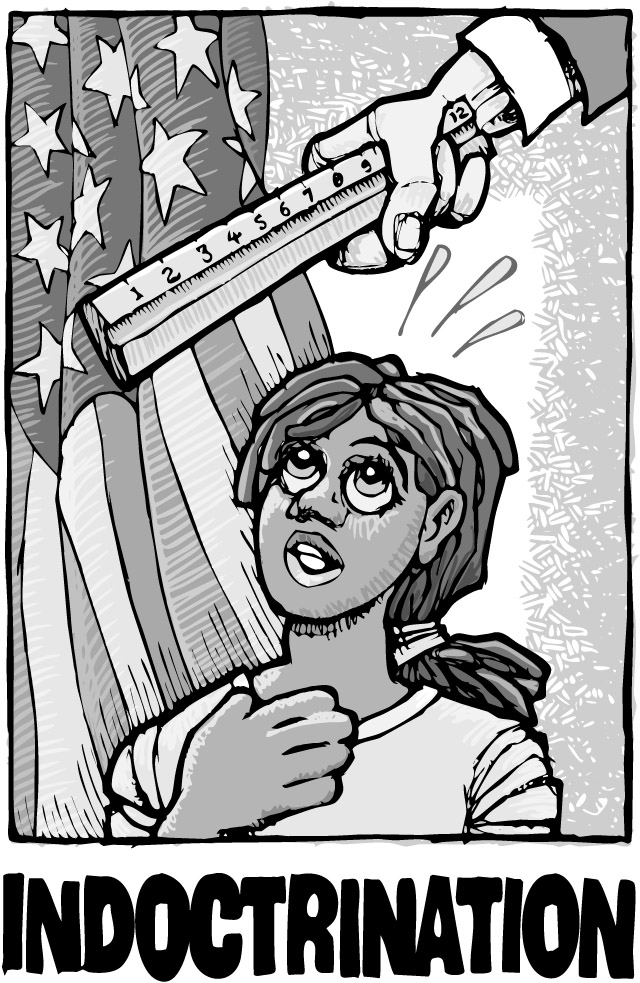
The American public is an easy thing to control thanks to indoctrinating practices such as the Pledge of Allegiance, the National Anthem, public education, patriotic rhetoric around every corner, and monolithic notions about American Democracy. As a teacher, I combat the notions of “American Exceptionality” everyday when kids bring to the classroom their inherited prejudices, biases, jingoism and ethnocentrism. The sources of these perpetuated notions are obvious, but how does one subvert them? Especially when one considers the power of the media—especially the ones that pretend to be “liberal” or “objective” (e.g. PBS, NPR, CNN, etc.)—who gives the American public the impression that we are being protected by their scrutinizing work. After all, we see people from both sides of the “spectrum” on their shows, don’t we? Forget the fact that the “spectrum” being presented by these networks as representative of human reality is so narrow that anyone who falls outside of the accepted spectrum is dismissed as “radical” or “irrelevant”. Thus, the media controlled by the corporate world (including PBS and NPR heavily funded by nefarious corporations) become an invaluable resource to the ruling class in the maintenance of the status quo. If the media does its job properly, people will believe America is full of meaningful choices as it pertains to their daily lives and that the true beauty of America lies in its ability to give everyone an opportunity to assert themselves in ways that will serve to better their individual lives. Again, this is understood by most Americans despite reality.

Along those same lines, one can almost hear those American centrists that never lose their hope that politics, “like life” they say so assuredly, is like a pendulum and so it has a way of balancing itself out. They say, like wise elders, that America swings to the left, then to the right, the back again. They too believe the spectrum of that swing has a broad back upon which the burden of “truth” is carried. Unfortunately, they fail to see that they only difference between a Democrat and a Republican (the spectrum of choice in this country) is the color of the tie they wear. More importantly, the notion that “truth” is sorted out through the inevitable swing of the pendulum assumes that the resulting center is somehow desirable for the masses forgetting that in all this time we’ve been a country, we’ve continued to ignore the millions of Americans that live in abysmal poverty; the perpetual violence our country has leveled against “enemies of our interests”; structural racism, sexism and homophobia; the irreversible damage we’ve done to our environment; the daily appearance of new and more profound disorders due to sped up lives and stress; and the inequality, shrinking freedom and diminishing democracy. But how long can we wait for the pendulum to be freed to swing to include the broadest spectrum of thought possible. I see this as the biggest problem with American notions of democracy. For that matter, I see our ruling class as opposed to democracy since it would be too free if it were to be embraced in the literal sense.

People believe in some ridiculous parallel between democracy and capitalism. Correlations are made between the balancing effect that the Legislative, the Judiciary and the Executive that democracy is supposed to have but does not, and the even more farcical notion that capitalism is free-market economics when it is anything but “free-market”. There are too many things that the majority of Americans do not understand about the authority that rules their lives. Perhaps through gaining an appreciation of the convoluted reality of American politics better helps explain why Americans vote against their own self-interest.

For anyone interested, I would highly recommend the book Pedagogy of the Oppressed, written by Paulo Freire, for thoughts and ideas on how one might go about the task of helping the oppressed see their oppressor. In other words, helping Americans see that their vote is simply a decision of who will be their oppressor, and end the cycle of Americans seeing their leaders as someone with whom they share anything meaningful.

Friday, February 03, 2006

What's So Bad About Democracy?


Could we all be naive to think the U.S. is letting matters in Iraq distract them from the bigger picture of Pax Americana? How much do we know about our country’s abilities to spy, invade, control, manipulate, deceive, and distract? If the war in Iraq is “unwinnable”, which the U.S. government has surely assessed by now, why not assume they are already planning for how they will regain control of Venezuela and the rest of Latin America? (Note the recent call by President Bush to increase the troop deployment to the border of Paraguay from 500 to 1400). For that matter, is it possible that the U.S. has downplayed coverage and attention towards Hugo Chavez in order to make silent preparations? Whatever the current plan is, the U.S. government’s immutable trend of opposing democracy continues undeterred.

The U.S. is clearly opposed to Hugo Chavez, Evo Morales and the “populist/socialist” movement in Latin America. Donald Rumsfeld stated his disdain for Chavez saying that he [Chavez] “was elected democratically, the same way Adolph Hitler was.” Couldn’t this notion apply to any democratically-elected leader? Say, George W. Bush? Again, possibly referring to his own country’s government, Rumsfeld continued to describe how “corruption is something corrosive for democracy.” Another recycled Reaganite—the much-reassigned and failed transitional ambassador to Iraq—John Negroponte, described how Evo Morales’ “administration is continuing to send confusing signals as to its intentions.” Overall, the U.S. is sending the message that it opposes the direction of Latin America, that Venezuela is the “biggest threat to the United States.” If that threat resides in its level of democracy, I would have to concur.

Over the last couple of years, the U.S. has aided in a failed coup d’etat in Venezuela (2002) through its financing of opposition groups through the National Endowment for Democracy and tactical support from our Navy in the Caribbean; ramped up “transition” plans for a post-Fidel Cuba (again with money from various groups including NED and USAID); overthrown the popularly-elected president of Haiti (Jean-Bertrand Aristide); supported and trained (through—surprise!—NED and USAID money) ruthless militias from Haiti to prevent the Lavalas political party from returning to power; continued its multi-billion dollar military funding of the Colombia army and paramilitary; undermined democracy by imposing its “free-trade” agreements in Central America; and now seems poised to oppose the newly-elected president of Bolivia if he allies himself with Chavez. It should be interesting to watch the presidential elections in Peru, where the candidate currently leading the some polls, Ollanta Humala, is another “left-leaning nationalist” and “friendly with Chavez.” Is it too wild to speculate the U.S. is already trying to influence these elections?

According to Noam Chomsky, the U.S. government has opposed democracy in Iraq since the invasion. In fact, he contends that the U.S. did everything in its power to “prevent” the elections that they were supposedly so intensely hurrying to implement. It’s the threat of democracy that most frightens the U.S. government. A true democratic society is likely to ask for more than the ruling class is willing to sacrifice. In fact, the most democratic thing the current U.S. government could do would be to create universal health care, since it is the one political issue most Americans agree upon at 70%. However, in the case of the U.S., it appears that democracy has its limits.

The title of a public talk given by Noam Chomsky that I attended was "Imminent Crises." He described the three crises he feels threatens our survival: global nuclear war, environmental destruction and the disappearance of democracy. It is therefore imperative that the "threat of democracy" be realized in popular movements such as those in Latin America. Likewise, a more vigilant, active and involved American public must come forward. Only by educating each other that the biggest threat to democracy in this world is our own country, can we end the tyranny our government poses to democracy around the world. Finally, it is utterly imperative that we not allow our own government to repeal more of our own freedoms at home as we descend towards fascism.