Friday, June 16, 2006

Rascism and Demagoguery in the Governor's Mansion


Dear Gov. Schweitzer and other "bashers",

What would be wrong with calling Governor Schweitzer a "dictator"? Would it be harmful? Would it be politically-incorrect? Would it simply be inaccurate? Or would it sound ludicrous, possibly driven by ideology or irrational prejudice?

On two separate occasions, Governor Brian Schweitzer (D-MT) called Hugo Chavez a dictator. In a 60 Minutes interview with Lesley Stahl, Schweitzer said: "'Why wouldn’t we create an economic engine that will take us into the next century, and let those sheiks and dictators and rats and crooks from all over the world boil in their own oil?' Schweitzer has called them rats and crooks and hasn't held back on bit. 'Hugo Chavez, the Saudi royal family, the leaders of Iran,' he said. 'How about the countries that end with 'stan'? Nigeria? You tell me. Sheiks, rats, crooks, dictators, sure.'"

Calling Hugo Chavez a "dictator" is harmful, irresponsible and deserves our strongest condemnation! Hugo Chavez has been DEMOCRATICALLY-elected three times (one was a recall referendum). Each of these elections were observed by myriad election observers from around the world.

The Organization of American States and the Carter Center held a joint press conference proceeding the recall election. OAS Secretary General Cesar Gaviria and Nobel Peace Prize winner and former U.S. President Jimmy Carter declared: "electoral observation mission's members had found no element of fraud in the process." In fact, several observers commented that the elections in Venezuela were much more legitimate than those in the U.S. (Florida 2000/Ohio 2004).

Interestingly, what people admire about Chavez and Schweitzer is their tough talk. However, a rational analysis of their rhetoric would bare extremely different results. For one, a rational observer would see that Chavez bothered to check his facts before commenting, while Gov. Schweitzer's comments would be an impassioned appeal to the prejudices and emotions of uninformed and frightened mass of Americans seeking order and security. The latter's comments more accurately describe the behavior of a dictator!

Gov. Brian Schweitzer clearly cannot mean what he has said on more than one occasion about Hugo Chavez, so we must disregard his comments. The reason he and others cannot have meant what they said is because of the level of deep rascism that it would require to hold this belief. By lumping Hugo Chavez, his majority supporters, the millions of Arab and Muslim people, or anyone who might oppose being treated as cogs in a machine that serves a miniscule minority into one group as "the sheikhs, the dictators, the rats and crooks around the world who are bent on destroying our way of life," is a textbook definition of rascism. This attitude conveniently ignores fact. To find the sheikhs, dictators, rats and crooks one need not look any further than the buried mirror that conveniently denies and defies honest self-reflection!

The overwhelming majority of people in Venezuela support Chavez (approval rating of Chavez is higher than Schweitzer's: 70%). National pride in that country is based in revolutionary missions that are serving a country's essential needs. Hugo Chavez has led a charge to feed, house, educate and medically treat its people. Hugo Chavez has criticized American foreign policy and stood up to ignorance and irrationality in a time of extreme rascism and global crises. Billions of people that suffer the effects of environmental devastation, smash-and-grab mentalities from imperial countries, and a rascist misunderstanding of their situation have found a powerful voice in Hugo Chavez.

Monday, April 10, 2006

Ending Isolation and New Beginnings


"The greatest trick the devil ever played was convincing the world he didn't exist."
--Verbal Kent in the film The Usual Suspects

Corporations have had similar success. These private tyrannies have been able to rape the world with very little effective resistance, especially in the country which harbors these criminal institutions. Alexis de Tocqueville warned us in Democracy in America that he knew of
"no country in which there is so little independence of mind and real freedom of discussion as in America." However, the unchecked and unqualified belief we Americans have in our democracy makes us much less aware of the oppressive institutions. We are effectively rendered powerless beyond an occassional trip to the ballot box.


I do find hope however, even if that hope is something that will likely need to be imported. Venezuelans are inspiring. When President Hugo Chavez was temporarily removed from office by a U.S.-backed coup d'etat, and Venezuelans had no leadership that was further hampered by a complete communication blackout, they spontaneously took to the streets despite vicious and brutal police repression. It was as though the collective consciousness of Venezuelans banded them together in solidarity and said, "Let's not allow this coup. Let's take our country back!" And that is exactly what they did. Without any leadership or central organization the people of Venezuela took their country back and resisted tyranny.

This kind of grassroots consciousness gives hope to the idea that the Bolivarian Revolution is much bigger than just one man. It gives hope that what really stands in the way of taking measures into our own hands is ourselves. Though the obstacle of forfeiting our material comforts and facing the most powerful institutions in the world is nothing to take lightly, it is worth considering the old adage of Karl Marx: "We have nothing to lose but our chains."

So if you're ready and would like to join me, let's start a revolution. Let's start creating our own security and order from within. Let's reassure each other that the constitutive tension we feel from being so dependent on everyone around us even though we know nothing about each other (both of which are effects of capitalism and the modern society: atomized yet interdependent) can be changed by taking our lives back and connecting. Join a social justice group or start your own. Whatever you do, get connected. Get to know the people in your community so we can stop fearing the people upon whom depend for all kinds of unknown reasons. Let's talk about issues and stop allowing the institutional terror that is isolating us to take control. We must stop fundamentalists and reactionaries from driving the collective consciousness of this nation towards greater fear and isolation. Let's unplug from the media, advertisers, fundamentalist clerics (Christian, Muslims, et. al.), government, and public education. Let's stop speaking truth to power and start speaking truth to each other! The revolution starts now!!!

Saturday, March 11, 2006

"Why do they hate us?"


President Bush and the power elites know the true answer to the question “Why do the hate us?” They know, for instance, that it is their very existence, self-serving over-indulgence, mass murder and policies of hate that have brought on the wrath of the world population. In order to avoid a correlation being made between the suffering/oppression abroad and that closer to home, the elite has depended on its most important institutions (education, religion, media, et. al.) to perpetuate a myth that Americans are “one nation, under god, indivisible, with liberty and justice for all.” Nothing could be farther from the truth. In fact, the working class of this country shares nothing but benign intent in common with the ruling class. Therefore, it must be a prime directive of American politics to clearly differentiate between the American working class and the rest of the world’s poor, colonial working class. The elite must seek to prevent Americans from empathizing—despite its basis in reality—with Muslims, Cubans, Colombians, Venezuelans, Vietnamese, Indians, Haitians, and Africans that have suffered imperial brutality for centuries. This way, those that “hate us” will not become Americans.

What do any of us share in common with the world’s powerful elite that is meaningful? For instance, I can’t use patriotism to buy food. I cannot pay for my medical bills with the “American Dream.” I cannot own a home with the Pledge of Allegiance. I cannot stop the most violent nation in the world from killing more innocent people with the “Melting Pot”, let alone the U.S. Constitution. (Hell, no one can stop the president from breaking the law these days!) Do we share their values? There is a pathetic manufactured perception that the American masses are “just like” their political and economic elite. However, evidence does not bring to bare this reality. Economically, this country’s inequality is a human rights violation. How can the wealthiest nation in the history of the world let its own people starve, live without homes, or equal access to health care? To deliberately perpetuate a class system, by refusing to end the cycles of poverty, and institutional, individual and social racism, this country’s elite—through its actions not its words—is loudly pronouncing just how much it appreciates the masses.

Taking for granted the uncommon ground we, the working class of the world, occupy—one that is morally high and righteous—and they, the ruling elite, occupy—one that is morally bereft and cruel, I would like to posit this: why do they hate us? That is, why do the elite hate us, not the other way around? They hate us because we control their future. We can refuse to do their work. We can refuse to fight their wars. We can refuse to shine their shoes. We can and must refuse to perpetuate their lies and myths.

Sunday, February 26, 2006

Socialism Will Smash the Capitalist World-Economy


While it is necessary for a socialist economy to be run for the benefit of the vast majority of the people rather than for a small aristocratic, plutocratic, or capitalist class in order for it to be considered “socialist”, its use of markets is not “unsocialistic”. In fact, socialist economies must adhere to the laws of the market as much as any other economy without being capitalistic. Therefore, a socialist economy can operate without contradiction or the risk of undermining its principles within the global market economy. It should therefore be understood that Venezuela’s exploitation of its only comparative economic advantage—oil—in the global capitalist markets is not a contradiction of principles. It would, however, lack socialist principles if the wealth generated from its oil failed to benefit the majority of its people. Most importantly, socialist countries such as Venezuela—unavoidably intertwined in the modern world-economy which is capitalist—must look to export its ideas above all else and help lead the systemic destruction of global capitalism. Backed by the momentum of Venezuela, global access to information and destabilizing societies across the world, socialism has reached an historical turning point and it must lead the way in shaping a more socially just and democratic world.

Capitalism and the World-Economy

One possible way to better understand socialism is to distinguish it from the capitalist system that dominates the world-economy. A capitalist economy gives priority to the endless accumulation of capital. However, if we say that a system “gives priority” to such endless accumulation, it means that there exist structural mechanisms by which those who act with “other motivations” are penalized in some way, and are eventually eliminated from the social scene, whereas those who act with the “appropriate motivations” are rewarded and, if successful, enriched.

According to economist and historian, Immanuel Wallerstein:

World-economy and a capitalist system go together. Since world-economies lack the unifying cement of an overall political structure or a homogenous culture, what holds them together is the efficacy of the division of labor. Historically, the only world-economy to have survived for a long time has been the modern world-system, and that is because the capitalist system took root and became consolidated as its defining feature.

Fortunately, the biggest weakness of the capitalist system is that it cannot exist within any framework except that of a world-economy. A world-economy with so many strikingly conflictive interests is too tumultuous for capitalism’s long-term survival, especially considering the explosion of readily-available and accessible information that is reaching more people in more manifold ways. Capitalism demands a very special relationship between its capitalists and the holders of political power. If the latter are too strong, their interests will override those of the economic producers, and the endless accumulation of capital will cease to be a priority. So what would this mean for capitalism if political power were held by an increasing number of people, the working class, or a “rogue” nation such as Venezuela? Another weakness of capitalists it that they require not only a large market but they also need a multiplicity of states that are willing to work in favor of “their interests”. This means that capitalists must work incessantly and exert massive efforts to maintain “their interests”. So how do capitalists ensure their future?

Socialization

Even in the modern world of mass information, households still serve as the primary socializing agencies. They seek to teach us knowledge of and respect for the social rules by which we are “supposed” to abide. They are of course seconded by state agencies such as schools and armies as well as by religious institutions and the media. But none of these come close to the family in actual impact. What however determines how the households will socialize in their members? Largely the way in which the secondary institutions frame the issues for the households demonstrates exactly how to socialize one’s family members. It also cannot be understated the how defenseless overworked and fractured families are to the effects of oppressive secondary institutions.

Of course, the powers that be in a social system always hope that socialization results in the acceptance of the very real hierarchies that are the product of the system. They also hope that socialization results in the internalization of the myths, the rhetoric, and the theorizing of the system. Although this does happen rather comprehensively in highly nationalistic countries such as the U.S., it never fully takes root (thanks to dialectical dissonance). On the other hand, there are some families that socialize their members to be rebellious, critical-thinking and self-reliant. To be sure, up to a point even such antisystemic socialization can be useful to the system by offering an outlet for restless spirits as long as the overall system is in relative harmony. In such cases, it is predictable that such anti-establishment socializations will have only a limited impact on the overall system. However, when the historical system comes into structural crisis (viz. 1960s) suddenly such antisystemic socializations can play a profoundly unsettling role for the system.

There is little question that across the globe today, people are more fully aware of the political issues that affect their personal lives then at any time in the past. They are more aware, more willing to struggle for their rights, more skeptical of the rhetoric of the powerful. More importantly, one not need look any further than Venezuela to see the effects of political power that is shifting into the hands of the masses. Venezuela’s example is a serious threat to the global capitalist system and this can best be observed in the extent to which corporate forces and secondary institutions are going to prevent there being genuine political democracy. As a socialist revolution, Venezuela’s Bolivarian Revolution could be the source of a paradigmatic shift away from a world-economy that “gives priority” to the endless accumulation of wealth.

One must remember that history is not at its end, and that every time elites have claimed some “golden era” which was reflected in their satisfaction with the status quo, events followed shortly after that highlighted the ridiculousness of those claims. Remember the decades that followed the “Roaring 20s” or the 1950s? Perhaps more salient to this discussion, can we all recall the victory dances of 1990s when grand pronouncements were made that socialism was forever dead, and capitalism has proven its superiority? So as we get closer to a point when the majority of the world is vastly more aware of the oppressive power structures and the capitalist system that is rushing us towards destruction, perhaps we will be able to think in terms of building a political economy based on systems of cooperation, equality, self-government, and individual freedom.

Sunday, February 12, 2006

Voting Against Yourself


Fellow blogger, Aprilloper, recently posed some important questions concerning American politics and its electorate. She asked why Americans vote against their self-interest. I wanted to try an attempt at answering this question. (Consequently, I ran headlong into deeper, more troubling issues I face everyday as an educator). An answer to this question would deepen an understanding of American politics and would provide directions in which one might begin deeper inquiries that would lead to positive solutions.

Here is a quote from an interesting book called Don't Think of an Elephant by George Lakoff. Lakoff is a linguist and cognitive scientist. This book tries to answer just such puzzling questions about the American public which seems, all too often, schizophrenic when it comes time to picking who their oppressor will be (i.e. election time). Here is one of his suggestions:

It is assumed that voters will vote their self-interest. Democrats are shocked or puzzled when voters do not vote their self-interest. “How,” Democrats keep asking me, “can any poor person vote for Bush when he hurts them so badly?” Their response is to try to explain once more to the poor why voting Democratic would serve their self-interest. Despite all evidence to the contrary, Democrats keep banging their heads against the wall. In the 2000 election Gore kept saying that Bush’s tax cuts would go only to the top 1 percent, and he thought that everyone else would follow their self-interest and support him. But poor conservatives still opposed him, because as conservatives they believed that those who had the most money—the “good” people—deserved to keep it as their reward for being disciplined. [In other words, they “earned” it]. The bottom 99 percent of conservatives voted their conservative values, against their self-interest.

It is claimed that 35 percent of the populace thinks that they are, or someday will be, in the top 1 percent, and that this explains the finding on the basis of a hoped-for future self-interest. But what about the other 65 percent, who have no dream that they will ever get that tax cut but still support it? They are clearly not voting in their self-interest, or even their hoped-for future self-interest.

[…] People do not necessarily vote in their self-interest. They vote their identity. They vote their values. They vote for who they identify with. They may identify with their self-interest. That can happen. It is not that people never care about their self-interest. But they vote their identity. And if their identity fits their self-interest, they will vote for that. It is important to understand this point. It is a serious mistake to assume that people are simply always voting in their self-interest.

Since the same people that market beer and SUVs to us are the same people that run a candidate’s campaign, it is easier to understand how people can be made to identify with candidates despite themselves. But, as Naomi Klein pointed out in No Logo, we are no longer buying products but instead image and identity. What this means to the question at hand is that it is irrelevant what the product can actually do as long as the consumer/voter is convinced that by purchasing (“voting”) a certain product, they are guaranteed a better, happier, sexier, more convenient life. Bearing in mind the frame that encompasses the lives of the majority of voting populace—an imposed “frame” that depicts for the hard-working, underpaid American patriot what it is that one needs and wants, such as “good ol’ American values”—the political elite can say what people want to hear and then get these people to vote from them despite their self-interest.

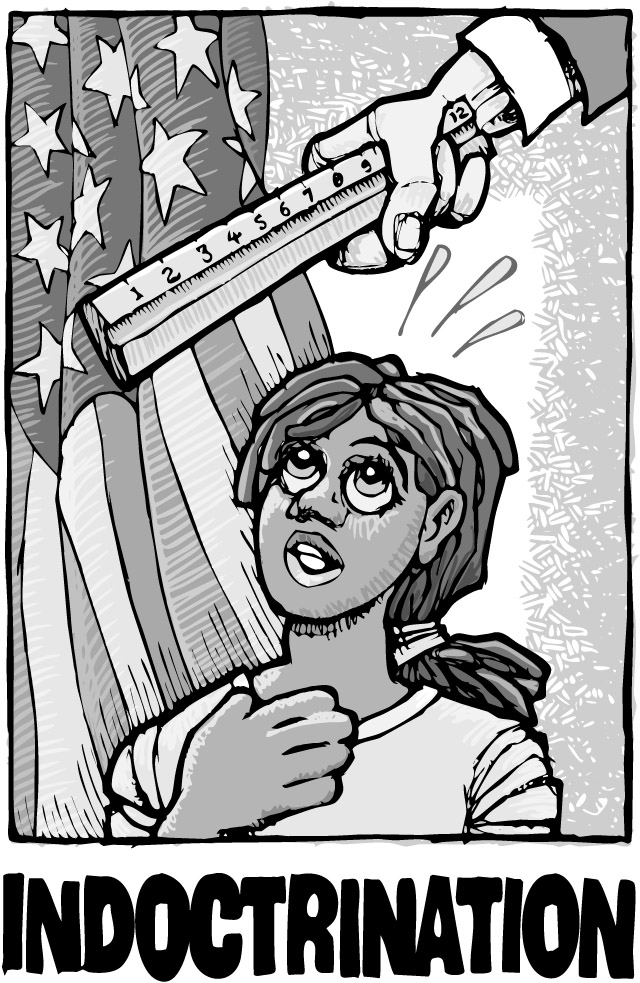
The American public is an easy thing to control thanks to indoctrinating practices such as the Pledge of Allegiance, the National Anthem, public education, patriotic rhetoric around every corner, and monolithic notions about American Democracy. As a teacher, I combat the notions of “American Exceptionality” everyday when kids bring to the classroom their inherited prejudices, biases, jingoism and ethnocentrism. The sources of these perpetuated notions are obvious, but how does one subvert them? Especially when one considers the power of the media—especially the ones that pretend to be “liberal” or “objective” (e.g. PBS, NPR, CNN, etc.)—who gives the American public the impression that we are being protected by their scrutinizing work. After all, we see people from both sides of the “spectrum” on their shows, don’t we? Forget the fact that the “spectrum” being presented by these networks as representative of human reality is so narrow that anyone who falls outside of the accepted spectrum is dismissed as “radical” or “irrelevant”. Thus, the media controlled by the corporate world (including PBS and NPR heavily funded by nefarious corporations) become an invaluable resource to the ruling class in the maintenance of the status quo. If the media does its job properly, people will believe America is full of meaningful choices as it pertains to their daily lives and that the true beauty of America lies in its ability to give everyone an opportunity to assert themselves in ways that will serve to better their individual lives. Again, this is understood by most Americans despite reality.

Along those same lines, one can almost hear those American centrists that never lose their hope that politics, “like life” they say so assuredly, is like a pendulum and so it has a way of balancing itself out. They say, like wise elders, that America swings to the left, then to the right, the back again. They too believe the spectrum of that swing has a broad back upon which the burden of “truth” is carried. Unfortunately, they fail to see that they only difference between a Democrat and a Republican (the spectrum of choice in this country) is the color of the tie they wear. More importantly, the notion that “truth” is sorted out through the inevitable swing of the pendulum assumes that the resulting center is somehow desirable for the masses forgetting that in all this time we’ve been a country, we’ve continued to ignore the millions of Americans that live in abysmal poverty; the perpetual violence our country has leveled against “enemies of our interests”; structural racism, sexism and homophobia; the irreversible damage we’ve done to our environment; the daily appearance of new and more profound disorders due to sped up lives and stress; and the inequality, shrinking freedom and diminishing democracy. But how long can we wait for the pendulum to be freed to swing to include the broadest spectrum of thought possible. I see this as the biggest problem with American notions of democracy. For that matter, I see our ruling class as opposed to democracy since it would be too free if it were to be embraced in the literal sense.

People believe in some ridiculous parallel between democracy and capitalism. Correlations are made between the balancing effect that the Legislative, the Judiciary and the Executive that democracy is supposed to have but does not, and the even more farcical notion that capitalism is free-market economics when it is anything but “free-market”. There are too many things that the majority of Americans do not understand about the authority that rules their lives. Perhaps through gaining an appreciation of the convoluted reality of American politics better helps explain why Americans vote against their own self-interest.

For anyone interested, I would highly recommend the book Pedagogy of the Oppressed, written by Paulo Freire, for thoughts and ideas on how one might go about the task of helping the oppressed see their oppressor. In other words, helping Americans see that their vote is simply a decision of who will be their oppressor, and end the cycle of Americans seeing their leaders as someone with whom they share anything meaningful.
Friday, February 03, 2006

What's So Bad About Democracy?


Could we all be naive to think the U.S. is letting matters in Iraq distract them from the bigger picture of Pax Americana? How much do we know about our country’s abilities to spy, invade, control, manipulate, deceive, and distract? If the war in Iraq is “unwinnable”, which the U.S. government has surely assessed by now, why not assume they are already planning for how they will regain control of Venezuela and the rest of Latin America? (Note the recent call by President Bush to increase the troop deployment to the border of Paraguay from 500 to 1400). For that matter, is it possible that the U.S. has downplayed coverage and attention towards Hugo Chavez in order to make silent preparations? Whatever the current plan is, the U.S. government’s immutable trend of opposing democracy continues undeterred.

The U.S. is clearly opposed to Hugo Chavez, Evo Morales and the “populist/socialist” movement in Latin America. Donald Rumsfeld stated his disdain for Chavez saying that he [Chavez] “was elected democratically, the same way Adolph Hitler was.” Couldn’t this notion apply to any democratically-elected leader? Say, George W. Bush? Again, possibly referring to his own country’s government, Rumsfeld continued to describe how “corruption is something corrosive for democracy.” Another recycled Reaganite—the much-reassigned and failed transitional ambassador to Iraq—John Negroponte, described how Evo Morales’ “administration is continuing to send confusing signals as to its intentions.” Overall, the U.S. is sending the message that it opposes the direction of Latin America, that Venezuela is the “biggest threat to the United States.” If that threat resides in its level of democracy, I would have to concur.

Over the last couple of years, the U.S. has aided in a failed coup d’etat in Venezuela (2002) through its financing of opposition groups through the National Endowment for Democracy and tactical support from our Navy in the Caribbean; ramped up “transition” plans for a post-Fidel Cuba (again with money from various groups including NED and USAID); overthrown the popularly-elected president of Haiti (Jean-Bertrand Aristide); supported and trained (through—surprise!—NED and USAID money) ruthless militias from Haiti to prevent the Lavalas political party from returning to power; continued its multi-billion dollar military funding of the Colombia army and paramilitary; undermined democracy by imposing its “free-trade” agreements in Central America; and now seems poised to oppose the newly-elected president of Bolivia if he allies himself with Chavez. It should be interesting to watch the presidential elections in Peru, where the candidate currently leading the some polls, Ollanta Humala, is another “left-leaning nationalist” and “friendly with Chavez.” Is it too wild to speculate the U.S. is already trying to influence these elections?

According to Noam Chomsky, the U.S. government has opposed democracy in Iraq since the invasion. In fact, he contends that the U.S. did everything in its power to “prevent” the elections that they were supposedly so intensely hurrying to implement. It’s the threat of democracy that most frightens the U.S. government. A true democratic society is likely to ask for more than the ruling class is willing to sacrifice. In fact, the most democratic thing the current U.S. government could do would be to create universal health care, since it is the one political issue most Americans agree upon at 70%. However, in the case of the U.S., it appears that democracy has its limits.

The title of a public talk given by Noam Chomsky that I attended was "Imminent Crises." He described the three crises he feels threatens our survival: global nuclear war, environmental destruction and the disappearance of democracy. It is therefore imperative that the "threat of democracy" be realized in popular movements such as those in Latin America. Likewise, a more vigilant, active and involved American public must come forward. Only by educating each other that the biggest threat to democracy in this world is our own country, can we end the tyranny our government poses to democracy around the world. Finally, it is utterly imperative that we not allow our own government to repeal more of our own freedoms at home as we descend towards fascism.

Wednesday, January 04, 2006

Bolivarian Socialism, What Is It?


"Si saber no es un derecho, seguro será un izquierdo." ~Silvio Rodríguez


There is a definite trend in Latin America towards the left. Over the last decade governments have grown increasingly cold towards Washington D.C. One can simply look at a map of South America and find that only few country’s governments are still taking orders from Crawford, Texas: Colombia, Paraguay, Ecuador and Peru (though changes towards the left are possible in the upcoming elections in Ecuador and Peru). The most obvious inspirations for this tack away from the “Washington Concensus” (a policy of neoliberal economics between the U.S. and Latin America) have been the Bolivarian Revolution, Hugo Chavez and Venezuela. Some have called what is happening in Venezuela “progressive,” “populist,” “socialist,” “democratic social reform,” or have even called it “revolutionary,” but the most commonly held belief is that this swing to the left in Venezuela—as well as the rest of Latin America—is inspired primarily by a sentiment of anti-U.S. imperialism. From this belief stems the hope that an end to U.S. intervention and meddling in the region will precede an end to suffering. This is an unfortunate perception because it only gives us half of the picture.
Credit must be given to Hugo Chavez and the Bolivarian Revolution for reinventing socialism for the 21st century and showing the rest of the world a way towards a more socially just future. Chavez’s unorthodox and open-minded approach to revolution is unique and deserves a more critical analysis. It should also be noted that the positive results and advancements of social justice are a result of the right of unfettered self-determination from inside Venezuela’s democratic government. In this case, as it is in all other, it was not due to the “benign intent” of white men in Washington making empty declarations of “freedom and democracy.” While the impact of the U.S. imperialism in Latin America over the last couple of centuries has been decidedly devastating, and an end to U.S. intervention would logically do a lot to reverse perpetual poverty and war, it should be recognized that the unprecedented achievements of the Bolivarian Revolution in Venezuela in such a short time is rooted—more than anything else—in the radical departure from capitalist/neoliberal economics and its decisive path towards a new kind of socialism.
This shift to the political left is marked by several major events over the last seven years, but it is undoubtedly highlighted by the Bolivarian Revolution in Venezuela. The ripple effect of the radical changes made by Venezuelan president, Hugo Chavez, is being felt throughout the Latin American region and has incited the wrath of the U.S. government who, according to Chavez, is planning his assassination and has even practiced war games (Operation Balboa) to invade Venezuela. There is little reason to doubt Chavez’s fears considering the U.S. government’s involvement in a failed coup attempt in April of 2002, as well as the recent fatwa issued by religio-politico Pat Robertson to “assassinate” the Venezuelan leader. What cannot be denied is that Venezuela’s revolutionary changes, radical social advances and its fierce anti-imperialist rhetoric has inspired popular social movements throughout Latin America and has bolstered other countries struggles to throw off their own chains of oppression.
Shortly after Chavez was elected, he advanced his social program by having 20,000 Cuban doctors brought into Venezuela to take care of people that had previously never seen a doctor in their lives. Chavez also brought in many more Cuban educators that began an unprecedented literacy program to empower the disaffected illiterate masses through education. He recognized, as did Castro, that if people are educated they can better defend themselves from the negative effects of anti-revolutionary propaganda. It is likely that Chavez received much of his inspiration from the Cuban Revolution and Castro himself. However, there is something that sets Chavez apart from previous revolutionary projects.
Chavez and the Bolivarian Revolution continue to buck the traditional trends of popular socialist movements from the past. Primarily, Chavez has—as of yet—not followed in the dictatorial footsteps of Soviet Bolshevism, Chairman Mao or the Cuban Revolution. One can even observe the peculiar expressions of some doctrinaire socialists who express frustration that Chavez is not following “the prescriptions” of socialism. It is as though they learned nothing from the past, and are concerned only that Chavez is not confining himself to a strict socialist doctrine. As a result, they are unable to recognize that Chavez’s departure from their stagnate socialist doctrine may indeed be the reason the Bolivarian Revolution has been successful thus far.
Chavez has done several things that would unnerve the likes of Castro, Mao, or Stalin. For example, 1) Chavez has not limited free expression. Chavez still faces a vituperative media which consists of an ultra-conservative corporation that owns twelve channels that are fiercely anti-Chavez. Chavez has refused, up to this point, to put any restrictions on the media or any other form of peaceful demonstration. Additionally, 2) he has not stifled the electoral process, as many of his predecessors had. During a referendum vote to remove Chavez from office in August of 2004, international election observers called it a transparent and fair election of the highest standard—especially compared to the 2004 presidential elections of the U.S. (Chavez won that election with nearly 70% of the vote). 3) Another difference is that Chavez did not execute or even imprison the plotters of the coup from 2002. Finally, 4) Chavez has still not expropriated all of the land and natural resources of Venezuela (though the redistribution of land is an important aspect of the revolution), but he has seen to it that all of Venezuela’s wealth from its natural resources was immediately used to benefit Venezuelan people.
The most striking difference of Chavez and other revolutionary leaders has been his effort to “decentralize” the government. This completely breaks with tradition. Chavez has encouraged the growth of grassroots organizing in the form of local level cooperatives. He believes this will eliminate the “corrupt bureaucracy” by putting the decision and means of making local level changes in the hands of cooperatives. When Chavez was elected into office in 1999, there were 762 cooperatives in Venezuela. Today there are 83,769 cooperatives that are concerned with “local development.” The cooperative policies “are adjusted to their specific conditions and employing local resources, equity and human development are prioritized. The official interpretation of ‘endogenous development’ also emphasizes the importance of local, diversified and sustainable development, and the commitment to respect Venezuelans’ different cultures and identities.” By embracing this kind of grassroots organizing, Chavez is genuinely placing the “means of production” (the central tenet of socialism) in the hands of the masses. Chavez is truly decentralizing his government and preventing all kinds of potential corruption and the concentration of power that led to the atrocious oppression in the Soviet Union.
Chavez has also reached out to other, more radical movements in Latin America and within the Bolivarian Revolution, namely the Worker-Occupied Factory Movement. In October of this year, Venezuela hosted the first-ever WOFM conference in Caracas. Chavez spoke at this conference inviting these spontaneous anarchists to advance their movement. Chavez spoke of the "potential of the workers in our continent to break their chains and leave capitalism behind". Again, Chavez is showing himself to be unafraid of letting the social revolution spread its wings through his explicit endorsement of the WOFM. Critical observers, including radical economist Michael Albert (founder of South End Press and author of Parecon, Life After Capitalism), have commented that “the Bolivarian revolution is most ideologically clear […] regarding political democracy and political participation where it seems to be already committed to a well conceived, compelling and innovative institutional vision that outstrips what any other revolutionary project since the Spanish anarchists has held forth.” By including the most radical proponents of social revolution in the advancement of this most definite human trend (libertarian socialism), “Chavez appears to be a remarkable detonator of insights, himself moving leftward at a great pace.”
It may be giving Chavez too much credit, but he very well may recognize that every previous socialist project stalled as soon as clamps were put on the most radical elements of the social revolution that had demanded a further shift to the left. Typically this happens through the concentration of power, the limiting of debate and criticism within the left-wing itself, and finally, through the rooting out and persecution the avant-garde. Up until this point, Chavez has not reacted as such and this may indicate his appreciation that people cannot be asked to be patient forever and once they see the potential of radical socialism they will clamor. Chavez has, up to this point, encouraged an open-minded and limitless approach towards socialism and the result has been the historically unique and radical Bolivarian Revolution.


Saturday, December 17, 2005

Venezuela, Bolivarian Revolution, and Chavez


"The trust of the people in their leaders reflects the trust the leaders have in the people." --Paulo Freire


The social improvements made in Venezuela over the last six years need to be thoroughly investigated and then appropriately recognized. Bringing more attention to the achievements of this "socialist" revolution are essential for the greater struggle for social justice in our world. It is easy to be cynical about the usually predictable reaction many Americans have towards socialism. For instance, most can't accept fact that "socialism" is capable of rewarding the widest section of any society with more equality, freedom and dignity than capitalism. (Furthermore, the material comforts that Americans have experienced through the capitalism of the U.S. has always come at a very high cost for masses of people who are intentionally obscured without a voice). However, I have also found that many non-socialist Americans are presently poised to listen because of growing dissatisfaction, the relentless campaigns of socialists around the world, and the shining examples being provided in countries such as Venezuela and Cuba. Many Americans are so disaffected by the politics and economic reality within the U.S. that such a discussion at this point in time is more possible than usual. In order to help translate the outrage masses of Americans feel towards the reality that they can't get basic health care, a dignifying job with a dignifying wage, etc., revolutionary leaders and educators must begin with what Paulo Freire describes as an essential faith that people will sense their oppression and work to overthrow it. Such faith is "essential" since most people will live up to the expectations the leaders have of them. Freire said that we must help people understand that their "ontological vocation is to become more fully human," but the first step is to exhibit a faith in people that they are capable of realizing such an existence. Finally, the quesiton remains as to how to counter the negative propaganda that Chavez and the Bolivarian Revolution face in order to amplify the message of positive gains being made by --gasp-- socialism! How do we get those Americans that are "too" comfortable to listen?

While it may be more effective to relate working class struggles here to the improved dignity experienced by peasants and working class of Venezuela, what issues are the middle class of the U.S. likely to be sensitive to in order to improve their hearing? I recently got into a discussion with a teacher from a very conservative area of Montana that began as a discussion of the overly-punitive nature of our schools and led to a full-blown discussion of Socialism. What I found was that this teacher was very intrigued and inquisitive about alternatives to tried, tested and failed attempts of market principles to solve the problems of equality in the U.S. What else can revolutionary leaders do to improve their chances of reaching out to more people? Interestingly enough, I have found that my family is the most difficult set of people to communicate these seemingly obvious facts about socialism to despite their own tendency towards socialist thinking.

Is it easier to get people to listen to the concrete examples emerging from Venezuela and be sensitive to the overuse of terms such as socialism bearing in mind the conditioning most Americans have towards "socialism"? That is, should we let Venezuela, Chavez and the Bolivarian Revolution's positive gains speak for themselves and then set the hook that what is happening down there is socialist? As an educator, finding points of access to my students is as important as any information and evidence I have compiled. I find this access through listening which is not always easy in public education that demands so much rote assessment. But I tend to agree with Freire that as my faith in my students wanes, so does their faith that they can change anything in their future. The result is inevitably that they stop caring.

How do we talk about the growing socialist movements of the world? What else beyond maintaining faith in people would Paulo Freire have to say?

Friday, December 02, 2005

Self-Managed Behavior vs. Typical Behavior Plans


Morality cannot really be imposed on a child, but must instead arise out of his/her own trials and tribulations. Likewise, this principle applies to behavior. A child must not be expected to intrinsically appreciate “appropriate” behavior that they have not manifested to be “appropriate” from within themselves. Building “Social Contracts” with peers through trial and error, while at the same time providing an emotionally safe environment to discuss what is and is not working, are essential needs for fostering the growth of intrinsically-motivated children. Therefore, formulaic behavior management plans employed by public schools throughout this country must be scraped onto the heap of Skinnerian Behaviorism that has only led to failed attempts to control and “manage” human lives. Conversely, “self-management” is logically the only approach to child-rearing and classroom management to have any long-term positive effect since it is generated from within; and at the same time, a child/student’s self-selection of an “appropriate” behavior is clearly the least coercive and least harmful, hence, the most desirable. Finally, only self-management can claim a genuine belief in the much-hoped-for goal of educating youth to be “self-reliant, independent, and critical-thinking.” It is necessary to state that there are instances when the assertion of authority is legitimate and not capricious: SAFETY. Such cases need only be discussed within context. If a child were about to run out into a street it is easy to prove that the assertion of authority was not arbitrary but legitimate.

When is the Resort to Violence Acceptable?


“A new society rises out of the actions that are taken to form it…” Noam Chomsky

Blogging has helped me grow. Through an extended debate on my last post concerning the moral validity of violence as a means to achieve revolutionary hopes, I was provoked and challenged by thoughtful bloggers that contributed to the debate until I finally stumbled upon a parallel debate on violence that Noam Chomsky had with Hannah Arendt and Susan Sontag, et. al. The debate truly opened my eyes and expanded my thinking on the moral dilemma of violence within a revolution. Although a perfect answer remains elusive even to the likes of these brilliant intellectuals, the argument provided by Noam Chomsky is the most rational discussion I have ever encountered on the topic. I strongly encourage a thorough read of this debate and would welcome any further discussion on this complex issue.

To read this debate, go to:
http://www.chomsky.info/debates/19671215.htm