Tuesday, May 29, 2007

More From a Decadent Empire


Don't you just love it? Around every corner is more proof of our lovely system's most endearing effects. This time it's about cheating. Cheating to get ahead. Cheating to look good. Cheating to please mom and dad. Cheating to please oneself.

Here is a fantastic survey taken by collegehumor.com all about cheating in American universities. There are some real doozies. My favorites? Well, let me be completely predictable and say I love the one that indicates that religious students cheat at a rate of 65.4% and non-religious students cheat at a rate of 58.3%. I love it! So much for the moral chumpass...err...compass.

There are some other real gems. How about the real basic 61% of all college students cheat!!! Or...perhaps the most significant in this system of have's and have-not's is that the average GPA of cheaters is 3.37 vs. a GPA of non-cheaters at 2.85. "Screw you teacher, if I'm going to get ahead in this world I'm gonna cheat. The system doesn't reward wholesome principles, or even actual knowledge...it rewards GPA!" A whopping 64.8% of men cheat versus a seemingly modest 42% of women. A sarcastic silver lining of solidarity can be found in the statistic that says that 45% of students allow others to cheat of them. Finally, students that cheat in school are 11% more likely to cheat in their relationships.

In my own high school classes I've decided to circumvent this banal tendency and simply told my students to go ahead and cheat if they want. Considering I've devalued the points they can earn from traditional classroom products such as exams, homework, etc. and based the bulk of their grade on effort and sacrifice, they find it rather pointless to cheat on any of my exams. Also, I randomly make exams worth 1000 or 2000 points to teach them of the pointlessness of grades. They never know what is worth more, a homework assignment, a test, a quiz or a presentation. They really have a difficult time letting go of the idea that I actually reward their in-class participation and attendance more than anything else.

Removing the pressure of a getting a good grade the majority of my students stay engaged in subject. They aren't competing against a system that rewards the "best," but a system that rewards their best efforts and the sacrifices of showing up. Our classroom environment is cooperative, challenging and flexible to the diverse interests, needs and learning styles of my students. My students have to un-earn an "A." And that is a very difficult task. It happens, but not often. The absence of pressure to succeed in the traditional format has invited learning for the sake of learning. We also don't bullshit each other with useless, decontextualized material. We delve into meaningful and pertinent topics. My students love engaging me in politics and cultural/social critiques. All the while, we are learning Spanish.

On the other hand, I offer no magical classroom management techniques to solve the problems colleges and universities face. Instead, I laugh and cringe at the real effects of a system that rewards greed, power, lust, luxury and self-interest. May the wheels fall off this Roman Vomitorium Bus soon!

Friday, May 18, 2007

Exploiting "Revolution"


Sonia-belle and I have been having a long exchange over my last post, which has now turned into this blog. The topic? Cuba.


This post is derived from the following comments and questions Sonia presented to me:

"Excellent questions, Che Bob.

(Che Bob asked: Did US corporations operating in Cuba prior to 1959 have to exploit and denigrate Cuban civilians to such a degree as to warrant and precipitate their removal?)

Do you really believe that Castro won his revolution because US companies were exploiting Cuban civilians ? If you believe that, ask yourself this: why Cuba ? Why not Bangladesh ? And if exploitation leads to revolution, why there was never a revolution (not even a strike) in North Korea in over 50 years.

I am not saying US companies weren't exploiting people. I know they were. But I know that THIS had nothing to do with people like Castro coming to power. Nothing at all.

The reality is that revolution occur not when oppressors are strong, but when the oppressors are weak. And they don't occur to replace oppressors by humanitarians. They occur to replace weak and indecisive oppressors by better oppressors - more ruthless and more cunning.

This applies to so-called 'leftist' revolutions (Russia in 1917, China in 1949, Cuba in 1960), but also (SURPRISINGLY) to so-called 'right-wing' revolutions - Romania in 1989 for example - there too, the ineffective Communist bureaucracy, unable to control the people anymore, was replaced by the latest, most ruthless version of capitalism.

If you really want to improve people's lives, evolution is the only ticket. Spain, South Korea, Taiwan and Chile - those are the most remarkable examples of positive changes in recent years."


My response:


I completely agree that revolutions mostly occur when oppressors are weak and not strong. This was certainly the case of Fulgencio Batista, King Louis XVI, King George III, Czar Nicholas II, Anastasio Somoza, and many others. I also agree that these weak and indecisive oppressors are often replaced by better oppressors— not always, but often enough. However, your logic does not compute when you admit that a weak oppressor is replaced precisely when he is weak, yet you cannot imagine how Castro was able to capitalize on Batista’s weakness and the historical disdain Cubans had for American imperialism (read: exploitation) that had been coursing through their veins since long before Castro. Castro, for all his faults (and there are plenty), reminded Cubans of the prophetic warnings of José Martí and the looming threat the U.S. posed to Cuba. Martí denounced and resisted the brutal and indentured slavery Cubans had endured under the rule of Spain only to see (posthumously) his descendents re-chained by oppressive American corporations under the weak, indecisive and puppet-like rule of Batista.

At the same time, I can only give cursory credit to Castro for the “revolution.” Revolution was in the Cuban blood long before Castro came along, the same way it has been in the Venezuelan society for much longer than Chavez has been on the scene. In fact, I deny Chavez’s and Castro’s cult-like following for the very reason that is stultifies the true revolutionary changes human beings seek when trying to escape oppression. Figures such as Lenin, Castro and Chavez co-opt and then stunt revolutionary change. Institutionalizing revolution with political parties and authoritarian bureaucracy they sap a revolution’s spirit and hope for genuine social and economic justice.

As far as North Korea and Bangladesh are concerned, I can only offer a guess that the extremely oppressive police state existence makes revolutions very difficult. In other words, the leaders of both these countries have ruled with a tight fist and continually crushed opposition. In other words, their grips are not weak. However, Bangladesh’s recent history has been littered with attempted insurrection, and general strikes only to see them crushed. Ironically, Bangladesh is officially recognized as a “parliamentary representative democratic republic.” Not unlike other ridiculously named “democracies” throughout history.

Which brings me to another concern: so-called “democracies.” Many democracies are by and large a complete sham when the industrial system is controlled by any form of autocratic elite, whether it is owners, managers, technocrats, a vanguard party, a state bureaucracy, or whatever. Whether State Socialism or State Capitalism, the classical liberal ideals cannot be realized under conditions of authoritarian domination or the orders of any boss including the supposedly "soulful elite" in the U.S. whose true goal is profit, power, and growth.

Besides, these false democracies have—in many cases—a far more insidious, coercive and oppressive power with which to control and dominate human beings. That is they give people the false impression of sharing wealth and power. They allow for ostensibly vigorous debate that straddles a digestible and allowable spectrum of opinion while dismissing all measure of divergent opinions that fall outside this permissible spectrum. This faux political spectrum amounts to a system of propaganda that undermines truly critical debate. Therefore, people in countries such as my own believe they are being challenged by our faux debates and that we have a vibrant political discourse here in the U.S. Under dictatorships, on the other hand, the propaganda machine presents itself as a bludgeon and is more likely to foment revolutionary/counter-revolutionary sentiments: Soviet Union, Argentina, Chile, Spain, China, Cuba (today and before 1959), Czechoslovakia, Poland, etc.

Violent discontent is pulsating in South Korea, so I’m not sure I would use that as a positive model. Likewise, the disparity between the wealthy and the poor in Chile has reached an all-time high and no ranks Chile 7th among its South American neighbors for wealth distribution. Yes, Chile has experienced tremendous growth, but so has the U.S. year after year. Unfortunately, fewer and fewer people enjoy the benefits of wealth production! Chile is far from a model society. Spain is rapidly devolving into a massively consumeristic society, propelled by its “hidalgo” complex. This complex demands obedience to those whom are able to create the most compelling aristocratic appearance despite economic reality. The wheels will definitely fall off that bus soon enough. As far as using Taiwan, I’m pretty sure that place is a sweatshop hell waiting to freeze over.

The biggest error I find among many of us here in the blogosphere is our silly struggle to identify the preferred historical model. I’m not satisfied with any of the political and economic models the world has to offer…so far. As far as I’m concerned, we have a long friggin’ ways to go and a short time to get there: hello Mother Earth!!

Monday, May 07, 2007

What Do We Do When We Are Wrong?

Over on the blog Left in East Dakota, two sworn opponents of the left, Beakerkin and Sonia, have made a mess of understanding the Spanish Revolution--among other things. But, likewise, it is all too common to observe their opponents (a group to which I belong) failing to admit faults and mistakes made within the historical trajectory of our ideologies. I do not imagine that Beak and Sonia simply lack the ability to read a book (both seem to be very sharp), but rather I believe their misconceptions are blindly driven by ideology. So what if they had read the same books as I did about the Spanish Revolution? Or if I had read their books (assuming they've read about the Spanish Revolution before commenting on it)? How much different would our understandings be? Would either of us be willing to be intellectually honest and cede ground to the other if evidence and reason mounted up against our ideologies?

In the aforementioned post (and many, many others throughout the blogosphere), a discussion ensues in the comments, and one cannot help but notice the hesitation by either side of the argument to give ground, even at the expense of intellectual honesty and rational discourse. Both sides are seemingly guilty of not admitting when they are wrong--historically or about politics today.

SPANISH REVOLUTION

George Orwell had to flee Spain in late 1937 thanks to the treachery of communists of the "right-wing" Leninist/Stalinist variety, socialists and moderate republicans who, like the Western democracies, had no interest in seeing the anarchist revolution succeed. Once again, we observe the threat of a good example. Orwell discusses this in his own words in Homage to Catalonia. I would prefer to take George's own word for it over that of an ideologue like Beakerkin.

In fact, as the historical record reveals, the anarchists (numbering over one million in 1936) were completely isolated by right-wing fascists, Western "democracies" and the whole slew of supposedly leftist groups. The Spanish "communists" (authoritarian version) were no more interested in the success of the social revolution than were the fascist for an obvious reason: power!

ABSOLUTE POWER CORRUPTS ABSOLUTELY

There is a tendency for corrupt, illegitimate and oppressive power consistent throughout history with all governments. It has been especially egregious wherever right-wing communism, and of course fascism, has emerged. But let's concentrate our criticism on the communist variety that far too many leftists attempt to defend. Let's look at Cuba, one of my favorite studies and a place I have experienced firsthand. While Cuba, like no other "communist" nation, has accomplished an unprecedented level of social and economic justice (bearing in mind that the stagnant economy cannot be discussed separate from the devastating toll of the U.S. Embargo), they have done little to distribute the political power of their nation and are guilty of all variety of human rights violations. But so are we here in the U.S. We allow millions to starve and live without homes in the wealthiest nation the earth has ever known. We make money off of other people's misery. We are as selfish and greedy a nation as the world has ever seen.

However, since many of us hate to admit it, let me say for my part that Cuba is not a democracy! A student asked me last week if I want to go live in Cuba, to which I responded, "hell no!" I love many of my rights here in the U.S., but I am appalled by--and want to change--the heinous inequality and social injustice we experience across this country. Not too mention most of what we enjoy materially, politically, and economically is as a result of imperial plunder. I hate what my country represents running roughshod over the world, stuffing its face with cake, committing war crimes, violating human rights on innumerable fronts, and on and on. I, like the Cubans I visited with on the streets of Havana, am displeased with all manner of sins committed in the bullshit name of my country. We must believe more can be done here and in Cuba and everywhere else. But rather than punishing good examples because it threatens our fragile little ideologies, have the stones and honesty to admit it when something is working to serve the common good.

Castro, like most all world leaders (ESPECIALLY U.S. PRESIDENTS), has committed many crimes and should be held accountable. Especially by those of us that claim to be struggling for social and economic justice.

INTELLECTUAL HONESTY

Beak and Sonia seem incapable of intellectual honesty or perhaps a nuanced answer when discussing politics and economics. At the same time, giving ground and admitting the horrific tolls of human lives destroyed under the name (AND NAME ONLY!) of "communism," or "socialism" is imperative. We do a tremendous disservice to the merits and value, not too mention those killed struggling for these ideals, by associating them with Soviet, Chinese, and other examples. Besides, we have plenty of ideologues to try to make blanket statements about socialism. We would be smart to never defend that which is obviously beyond defense.

Perhaps we all need to ask ourselves the question my student asked me: "Would you live there?" Would any of us on the left have wanted to live in the Soviet Union, China, Cuba, etc.? Would those on the right have wanted to live under Pinochet, Videla, Franco, etc.?

Wednesday, May 02, 2007

Justice!


"The ruler, the capitalist, and the priest rested that afternoon in the shadow of an ash tree whose leaves shined brightly in the mountain canyon.
The capitalist, visibly agitated, mashed a red booklet into pulp with his hands, and said between sighs:
"I've lost everything: my fields, my cattle, my mills, my factories; everything is under the power of the ragged bums."
The ruler, trembling with rage, said:
"This is the end. Nobody respects authority anymore."
And the priest raised his eyes to the sky and said remorsefully:
"Damned reason! It has killed faith!"
The three estimable persons thought, and thought, and thought...The previous night had seen fifty revolutionaries storm into the village, and the working people who lived there had welcomed them with open arms; and while the revolutionaries were searching for the ruler, the capitalist, and the priest to demand of them a strict account of their acts, they had fled to the canyon seeking refuge.
"Our domination of the masses has ended," said the ruler and the capitalist in a single voice.
The priest smiled and said, in an assured tone:
"Don't worry yourselves. It's certain that faith has lost ground, but I can assure you that, through the means of religion, we can recuperate everything that we've lost. At first glance, it appears that the ideas contained in this damned booklet have triumphed in the village, and they will certainly triumph if we do nothing. I don't deny that these evil ideas enjoy a certain sympathy among the common people; but others repudiate them, above all they repudiate those that attack religion, and it is among these that we can foment a reactionary movement. Fortunately, we three could escape, because if we'd have perished at the hands of the revolutionaries, the old institutions would have died with us."
The capitalist and the ruler felt as if a great weight had been lifted off their backs. The eyes of the capitalist flashed, burning with greed. How? How could it be possible for him to return to enjoying the possession of his fields, cattle, mills, and factories? Had it all been nothing but a cruel nightmare? Could he return to having all of the people of the region under his power, thanks to the good offices of religion? And, rising to his feet, he shook his fist in the direction of the village, whose country houses shined brilliantly white beneath the sun.
The ruler, emotionally, said with conviction:
"I have always believed that religion is the firmest support for authority. Religion teaches that God is the primary boss, and that we rulers are his lieutenants on Earth. Religion condemns rebellion because it holds that the rulers are above the people by the will of God. Long live religion!"
Fired up by his own words, the ruler snatched from the hands of the capitalist the red booklet, tearing it to shreds and throwing the scraps in the direction of the village, as a challenge to the noble insurrectionary workers.
"Dogs!" he cried. "Recieve this along with my spit!"
The scraps of paper flew happily away, blown by the wind, like big toy butterflies. They were the Partido Liberal Mexicano manifesto of September 23, 1911.
The first shadows of night began to fall in the valley, and in the twilight one could see waving, above one small house in the village, a red flag bearing in white letters this inscription: "Land and Liberty." The ruler, the capitalist, and the priest screamed, waving their fists at the village:
"Nest of vipers! We'll soon crush you!"
The final rays of the sun still shone in the west as it set; the frogs began their custormary serenade, free, happy, ignorant or the miseries that men suffer. In the ash tree, a pair of songbirds sang their song of free love, free of judges, priests, law clerks. The peaceful beauty of the hour invited the human heart to manifest all of its tortures, and for those sentiments to materialize in a work of art.
Making even the rocks shake, a formidable cry rolled up the canyon: "Who is there?"
The ruler, the capitalist, and the cleric trembled, anticipating their end. Night had finally laid all of the rays from the sun to rest; the songbirds grew quiet; the frogs fell silent; a gust of wind agitated frighteningly the branches of the ash tree; and in the darkness, frightfully, returned the ominous cry: "Who is there?"
The three estimable persons remembered in a single second their crimes: they had enjoyed all the good things of life at the cost of the suffering of the humble; they had maintained humanity in ignorance and misery in order to satisfy their appetites.
The sound of energetic footsteps grew louder: they were those of the soldiers of the people, of the soldiers of the social revolution. A round of gunfire left rolling in the dust, without life, the representatives of the hydra with three heads: Authority, Capital, Clergy."

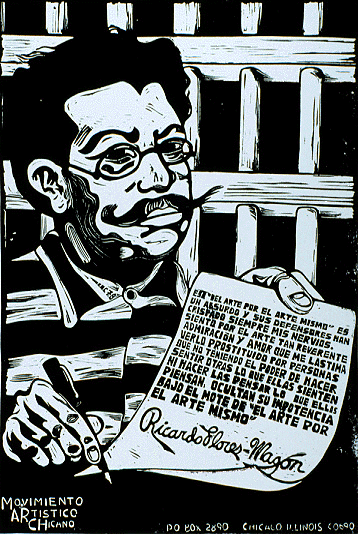
-Ricardo Flores Magon, Regeneracion, November 13, 1915.

Saturday, April 21, 2007

Debunking Choice

"The Gringos provide the weapons, Colombia provides the dead," reads a billboard near the home of Yaneth Perez who recently spoke across the state of Montana. This is Yaneth's second visit to the Big Sky country in as many years. On this particular visit to Montana she spoke in front of 18 different audiences to as many 800 people. Fortunately, nearly 375 of those able to hear her speak were high school students!

Hallelujah! because at least some high school students in Montana were exposed to the firsthand testimony of an actual Colombian whose real lived experience differs from the doctrinal version sold hook, line and sinker to them the rest of the 179 school days! Surely, dozens of those high school students didn't pay attention or even care what Yaneth had to say, but for many others, seeds of doubt and serious questions about U.S. foreign and economic policy were raised.

As I was in attendance at four of the high school presentations, I can attest to the high level of concern Montana high school youth expressed for Yaneth's precarious existence. And as Yaneth explained to them the role American lifestyle plays in the wide-spread killings in Colombia through the consumption of cocaine and oil, these students were moved. They were moved because unlike the vast majority of adults who live in massive denial about the effects of their lifestyles and who don't get the most basic lessons of economics, the high school students understood that if we stopped providing the demand then it would follow that Colombians would stop killing each other in order to provide the supply.

As a side note, one of the most disconcerting tendencies I've heard out many of my own students this year is the notion that choice plays a significant role in the harsh realities most of the world suffers. Nearly 70% of my students believe people choose to be poor, homeless, etc.! If there were one single aspect of American indoctrination that most concerns me, it is this bullshit myth.

American culture provides us with so much in the way of meaningless choices (thousands of cold beverages, shoes, etc.) that we begin to assume all areas of our lives are a matter of choices. Choices that are simple to understand, but difficult to discipline ourselves to take. Ah! discipline. If only we were all as "disciplined" as the wealthy! At least 70% of my students are convinced that "making it" is a matter of their choosing. On the other hand, they are equipped with an excuse already made for them, that if they don't "make it" it was due to poor choices and lack of discipline. In other words, they chose not to overachieve and strive and assuredly the disinterested economic and political structure had nothing to do with it. In fact, many Americans may go so far as to believe these structures provide encouragement and assistance when discipline is present. In other words, they not only failed themselves, but they failed a benevolent system and have become a drag on the whole society. Besides living in poverty, the poor should feel ashamed of having wasting a golden opportunity! A basic assumption these students are making is that these structures are in essence benign and simply a matter of disciplining oneself to learn how to navigate their complex labyrinth.

Someday soon, many of these high school students will become American adults and will join their parents in undisciplined choices, denial about the role their lifestyle plays in the rest of the world and the orgy of thoughtless consumption. Thanks to some teachers efforts to demystify American myths and deconstruct power relationships and expose the omnipresent institutional flack machine, some students may begin to question things as they seem. Thanks to Yaneth Perez, an unmediated actual person, at least a number of them have now heard some of the "unofficial" story.

Tuesday, April 17, 2007

Been Caught Thinking


Thanks to Troutsky and his tagging me with a Thinking Blogger Award, I'm going to have to start thinking about my thinking!


Here are five bloggers that keep me thinking
:

  1. Aprilloper at Idaho Blue is not a frequent blogger, but offers deep reflections about our world and looks at a diverse range of topics. Were she not so busy being a mother, running her businesses, remodeling her home, and volunteering perhaps she would give more time to blogging. Or perhaps she says just enough.
  2. Marie Trigona at Latin American Activism is on the front line of important struggles throughout Latin America. Her dedication to libertarian struggles in Argentina are one of a kind in the blogosphere.
  3. Graemeanfinson over at Left in East Dakota is another thoughtful blogger. He keeps me laughing with all variety of blogs. Not too mention, his sight honors the IWW!
  4. Very little need be said about the Mutualist Blog, but it definitely keeps me on my toes and gives me plenty to ponder.
  5. Without a doubt, Thoughtstreaming is the blog I always start with for my daily dose.

Should you choose to participate, please make sure you pass this list of rules to the blogs you are tagging.

The participation rules are simple:
1. If, and only if, you get tagged, write a post with links to 5 blogs that make you think,
2. Link to this post so that people can easily find the exact origin of the meme,
3. Optional: Proudly display the ‘Thinking Blogger Award’ with a link to the post that you wrote.

Sunday, March 11, 2007

Bush Unwelcome in Latin America


A quick browsing of CNN Español’s online video clips reveals the continent-wide hatred our latino neighbors reserve for our commander-in-chief—the government’s devastating economic and political policies in tow. Meanwhile, protests have erupted throughout Latin America where President Bush is desperately seeking a place to land Air Force One where he might be welcomed. Instead, Latin Americans from Guatemala to Argentina are reminding Bush that should he land his airplane in their territory it will be to voices chanting in unison: “asesino” (“murderer”).

Of course, this ire should not belong to Bush alone, as he is only the most current version of imperial master. After 500 years of regional oppression, isolation and division Latin Americans are looking increasingly towards each other for solidarity. Loosely modeling of regional integration after the European Union, today’s Latin American leaders Hugo Chavez of Venezuela, Rafael Correa of Ecuador, Lula da Silva of Brazil, Evo Morales of Bolivia, Nestor Kirchner of Argentina and Tabare Vazquez of Uruguay are rejecting American foreign and economic policy in lieu of their own trade and diplomatic agreements.

Notable among the majority of voices rejecting Bush is one dissenting voice: American ally Alvarez Uribe of Colombia. Not surprisingly, Colombia is the third largest recipient of American military aid and is seeking to have President Bush extend our nation’s inhumane aid package called Plan Colombia. This U.S. taxpayer-funded “plan” has led to the loss of ten of thousands of innocent lives, environmental destruction and made possible the continuation of an insanely brutal war. Conspicuously absent from the list of nations highlighted in the easy-to-dismiss “Human Rights Report” issued by the U.S. each year (besides itself) was Colombia where thousands of people are killed every year at the hands of Colombia’s military/para-military forces that our glorious government funds. Does hypocrisy and irony know no limit?

Tuesday, March 06, 2007

Getting Horizontal


If you have not already read or heard of a newer book called Horizontalism by Marina Sitrin, RUN—DO NOT WALK—TO FIND IT.

This amazing collection of voices emerging from the nearly-impossible-to-describe Argentine reality is revolutionary. This book works ontologically to discuss all variety of issues including power structures, language, participatory politics and economics, among other important social issues.

Even now, as I try to recapitulate this book’s assessments I am denied access. The point is Argentines are recreating, reinventing and defying reification. I have even had a discussion with an American who recently returned from his stay there that spanned several years. The voices and testimony provided in this book have even eluded him despite his sincerest intentions and seemingly open mind.

If the voices Sitrin collected from across Argentina continue to exist there, it would seem there is ample reason to have hope that a complete reworking of civilizations is possible. Entire communities are asking deeply critical and existential questions about the nature of our old and out-dated ways of thinking.

“Hope,” however, is not to be confused with utopia. What is being discussed, discovered and practiced is sticky, messy and painful. However, presuppositions about the untenable contradictions of capitalism have put many of these Argentines on the doorstep of deciding to permit the dissolution of humanity or create a whole new civilization. At the same time, these horizontal processes and movements are equally suspicious of all of history’s revolutions. They seem determined, in many cases, to avoid co-optation by leftist politics as well. As the voices in the book continually resound, they are seeking new paths for organizing their societies.

In college, getting “horizontal” had an all too banal meaning. That too is being reworked in my mind.

Friday, March 02, 2007

Teachers in a World of "Shock and Awe"


As if teachers don’t get enough blame heaped on them, I’m going to heap some more. Being a teacher myself, I deserve a share of the criticism. It seems that we teachers are completely oblivious to the hypocrisy of our “do-as-I-say-not-as-I-do” approach to education. We also have a tremendous knack for criticizing our students for not learning things we never teach them, namely causality, critical thinking, and self-reliance. Some mention should be made that whatever negative impact we desperate teachers could be having on today’s youth, it pales in comparison to the “shock and awe” society-at-large, which includes our government, corporate capitalism and its lackey media, and the resulting deterioration of family life. However, it is my contention that teachers have a unique opportunity to provide hope for future generations by standing up to manufactured political “controversies” and discuss head-on the issues that pervade a student’s mind. We must demonstrate a willingness to confront society’s hypocrisies, social injustice, and global crises instead of perpetuating America’s hopeless delusions of exceptionality, success through bootstrap discipline, and our divine blessing.

“Shock” is exactly how I felt when I heard the news that at my high school several kids premeditated an attack of another kid in order to capture it on their cell phone video cameras. The goal was to upload it onto the Internet. The attacked kid went into convulsions and was hospitalized. “Shock” rules the day in an increasingly irreverent and impulsive society. However, the responses and reactions I heard teachers making were equally dismaying. Here is where the hypocrisy of educators begins.

We act shocked and surprised that our youth are acting out and impulsive yet my fellow teachers vapor locked when I asked them to look at the society of “shock and awe,” right down to the language chosen by our leaders to carry out a murderous rampage on innocent lives. Our act in Baghdad was an utter act of irreverence for human life and we titled it “shock and awe.” Shock jock radio and shock jock TV (Jackass) are stepping up their campaigns to shock, including a recent on-air death of a mother trying to win her son a Nintendo by drinking two gallons of water without urinating. She died from drowning her own tissue. (Radio station employees got fired, young child lost mother). One upping and shocking is rapidly devolving the most basic levels of common sense. What could this be saying about the subconscious thinking of our decadent society? Nihilism? Zero sum?...Or are we desperate to wake up from our “idiocracy”?

Enter the teacher. We have an opportunity to teach accountability by modeling it before we demand it from our students. If I was in a student’s shoes, I’d wonder what the fuck kind of hypocrite my teacher was for asking me to act more responsibly and to hold myself accountable when all around me I see the adults in society failing to hold their government accountable for crimes against humanity, and human rights violations. As a student I’d be outraged that a teacher demanded from me accountability when in textbook Orwellian fashion I perpetuated obvious lies for the sake of ideology. A psychological study needs to be done on teens in this country that aimed at assessing the anger festering in our youth on a latent/subconscious level as they must clearly know they are being handed off a much more fucked up world environmentally and geopolitically than we were given.

A common complaint among my colleagues is that “kids today don’t get causality.” As if irony knew no limits, these teachers don’t know why! Just to be snarky and smug, I sometimes ask them why they think that is. Sad to say the usual responses deflect blame from our dear old profession. So I say again, “modeling for students what we expect them to learn might yield fruit.” Besides that we can do a revolutionary thing: we can teach it! That’s right, we can teach causality. I’m pretty sure the kids get that straightforward concepts of causality they learned in science class, but they rarely see it applied by their teachers, let alone the rest of society.

In fact, I asked my students why it was we (our media, educators, government, et. al.) don’t ever seem to discuss the causes of a massive immigration problem, but instead deliberately choose to study and cover the effects down to the very last detail. I am proud to say one of my students was quick to reply, “because we won’t like what we see when we look in the mirror!”

Even if we think kids aren’t listening they are. It’s just they are good at tuning out the bullshit. When a teacher decides to be honest and stop presenting the world as a clean, linear, desexed Elysian paradise for the disciplined few, and instead models how a committed individual should be denouncing hypocrisy, social injustices, and resisting illegitimate authority without utopian illusions, that is when students may start to truly listen. However, for many school is already a lost cause and surviving it is a major struggle. Needless to say, teachers are in a unique position to model accountability beyond faux democratic processes such as voting. Teachers could get their asses organized and pressure the institutions that undervalue education, rather than modeling excuse-making. It’s no wonder students feel powerless and hopeless. Where in society do they see it modeled?

Ecuador's New Government

lonestone revolution: Latin America News Review: Ecuador's New Government Talks Default on Debt: Latin America's New Reality